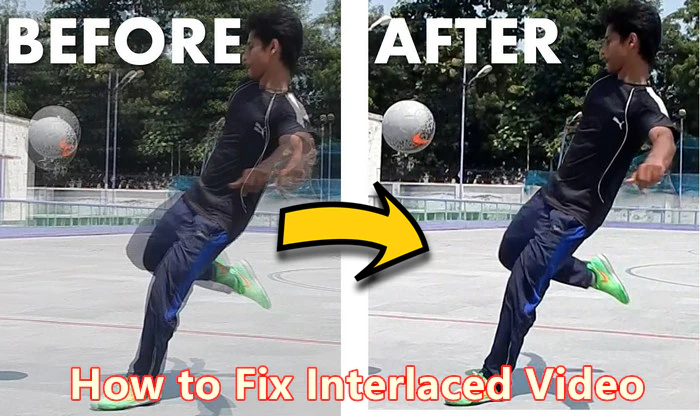
How to Fix Interlaced Fuzzy Video
An interlaced video stores each image as two fields rather than one complete progressive frame. One field contains the odd-numbered scan lines and the other contains the even-numbered lines. These fields are normally captured at slightly different moments in time, so fast motion can reveal comb-like horizontal edges when the fields are displayed incorrectly on a progressive screen.
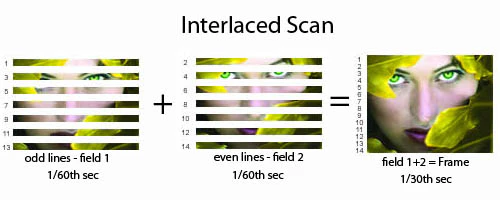
Field 1 and Field 2
Video can be scanned in two basic ways: progressive or interlaced. Knowing the difference helps you decide whether deinterlacing is necessary.
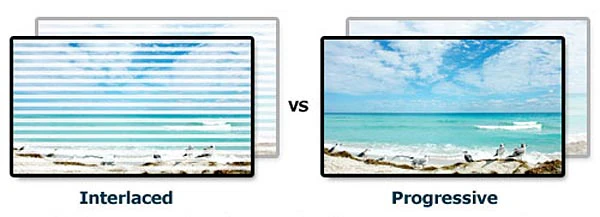
Progressive Scan VS Interlaced Scan
Progressive scan: Each frame contains a complete image, with all lines displayed in sequence from top to bottom. Progressive formats are commonly marked with a "p", such as 480p, 720p, or 1080p.
Interlaced scan: Each frame is represented by two alternating fields: one with odd-numbered lines and one with even-numbered lines. Interlaced formats are commonly marked with an "i", such as 480i, 576i, or 1080i.
Interlacing was widely used in analog and broadcast video because it could provide smoother-looking motion while working within limited transmission bandwidth. Deinterlacing is the process of reconstructing progressive frames from those interlaced fields. Depending on the algorithm, a deinterlacer may weave fields together, interpolate missing lines, or use motion-adaptive processing to reduce combing while preserving as much detail as possible.
Here is the best solution to fix videos interlacing issue. With the handy and useful deinterlacer, you're able to play your videos on any device without issues.Learn more >
Modern computer monitors, phones, and flat-panel TVs display progressive images. When they receive interlaced content, the player, graphics pipeline, or display must deinterlace it before showing it. If that processing is missing or ineffective, moving objects can show obvious combing or jagged horizontal lines.
You do not need to deinterlace every video. If the source is already progressive, applying a deinterlace filter can soften detail unnecessarily. For occasional playback, a player such as VLC can deinterlace on the fly without changing the file. If you need a progressive copy for editing, sharing, archiving, or playback on devices that handle interlaced footage poorly, use a converter or transcoder to create a new deinterlaced file.
WonderFox Free HD Video Converter Factory is a free Windows video converter with a built-in Deinterlace option. It is useful when you want to create a new progressive file instead of only hiding interlacing during playback. The process takes four straightforward steps.
Free HD Video Converter Factory can convert interlaced footage to a progressive output in a few clicks and lets you choose the output format before processing. Learn more >
Download, install, and launch this freeware on your Windows PC. Open "Converter" and click "Add Files" or simply drag the video you want to deinterlace into the interface.
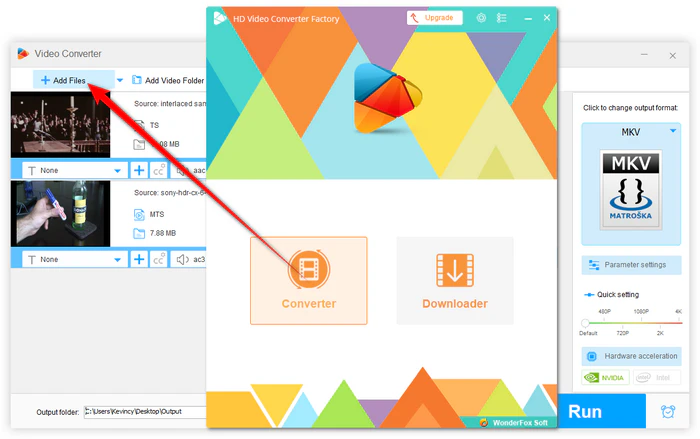
Import Interlaced Video
Expand the Output Format list on the right and choose the format or device profile you need. MP4 is a practical choice for broad compatibility, but you can keep another suitable video format when required.
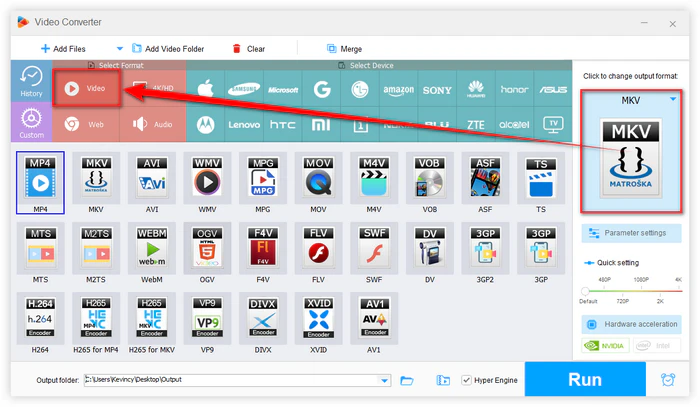
Select an Output Format
Open the "Parameter settings" window, and choose "Yes" in Deinterlace drop-down menu. Then click OK to save the change.
For advanced users, you are also able to change video codec, bitrate, audio settings, etc.
Tip: If your only goal is to remove interlacing, keep the original resolution and frame rate unless you have a specific playback requirement. Unnecessary resizing or frame-rate conversion can introduce additional quality changes. In addition, this tool is also capable of rotating video, cutting video you have, adding subtitles into them and merging multiple videos into one.
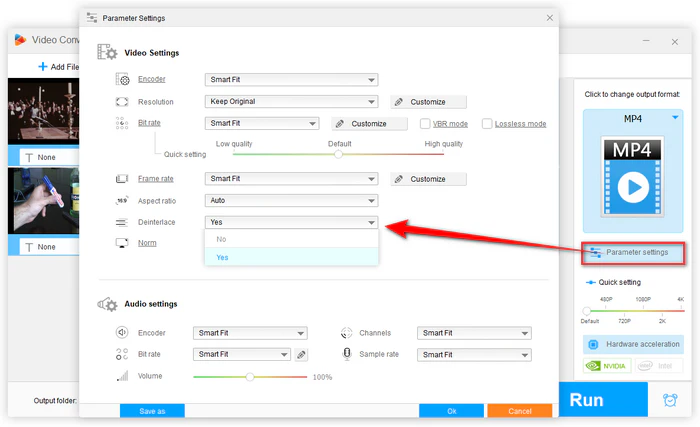
Enable Deinterlace Option
Click the triangle icon at the bottom to specify your output folder and hit the "Run" button to deinterlace your video.
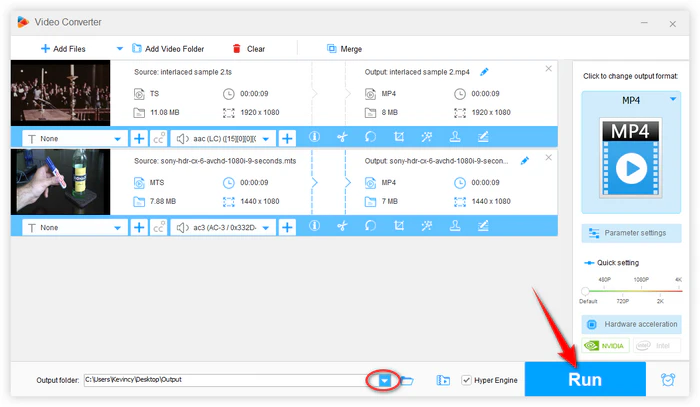
Enable Deinterlace Option
The software will create a new progressive video, so the deinterlacing change is permanent in the output file. Processing time depends on the source, output settings, and computer. Because deinterlacing normally requires video re-encoding, some quality change is possible; using sensible output settings helps preserve detail.
The final result is listed below.
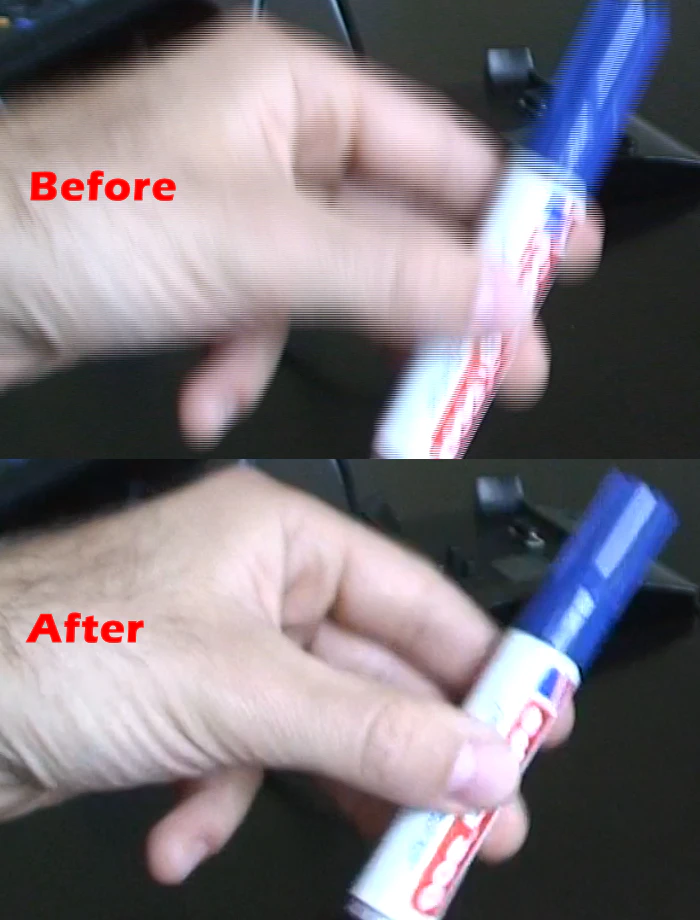
The Before-and-After Comparison
VLC Media Player is a good choice when you only need clean playback and do not want to create a new file.
Open the interlaced video, click Video on the menu bar, go to Deinterlace, and choose On. You can also press the default D hotkey to toggle deinterlacing on or off quickly.
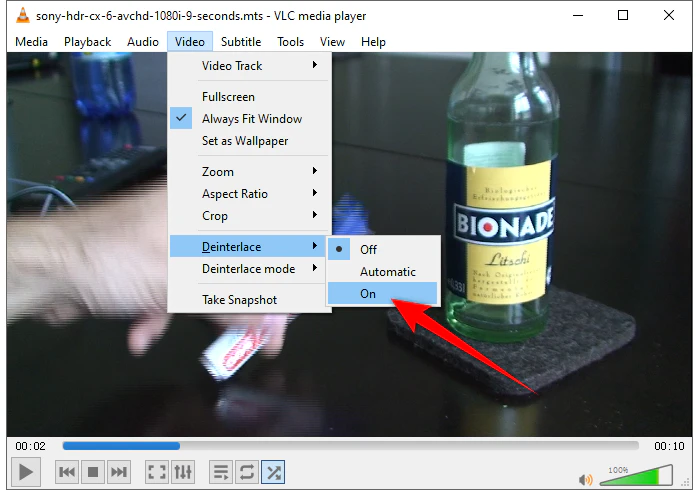
Video Deinterlace in VLC
For a more persistent setting, go to Tools > Preferences > Video. Under the Video section, set Deinterlacing to Automatic or On, and choose a mode from the available Mode list. Automatic is a sensible starting point when you play a mix of progressive and interlaced files. The exact modes shown can vary by VLC version and platform. Click Save after making changes.
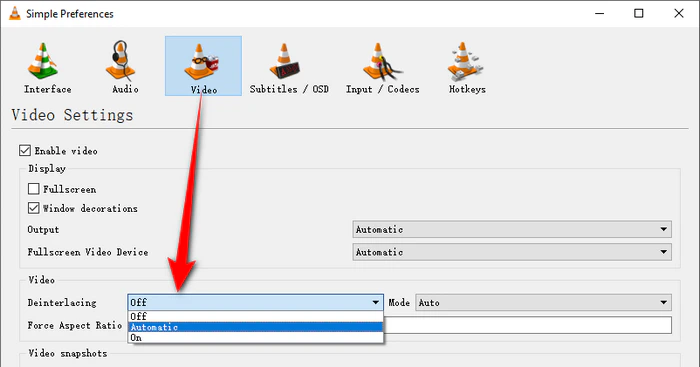
Video Deinterlace in VLC
If VLC deinterlacing appears to have no effect, try Tools > Preferences > Input/Codecs > Hardware-accelerated decoding, set it to Disable, restart VLC, and test again. This is only a troubleshooting step: disabling hardware decoding can increase CPU usage, so re-enable it if it does not help.
VLC's playback deinterlacing does not modify the original video. If you move the same file to another player or device, the combing may return unless that device also deinterlaces it. Use Method 1 or Method 3 when you need a new progressive file.
HandBrake is a free, open-source transcoder for Windows, macOS, and Linux. It offers more control over interlace detection and deinterlacing, which is useful for mixed or difficult sources.
Open the source video, choose an output preset, and switch to the Filters tab. In recent HandBrake versions, you can use Interlace Detection together with a deinterlacing filter such as Decomb, Yadif, or Bwdif (the exact choices depend on the version). Interlace Detection lets HandBrake apply deinterlacing only to frames where combing is detected. Then set the destination and start the encode.
For many sources, Decomb with interlace detection is a practical starting point because progressive frames can be left alone. If the source is telecined film rather than truly interlaced video, use HandBrake's Detelecine filter instead of applying deinterlacing blindly. HandBrake requires re-encoding, so processing may take longer than VLC's playback-only method.
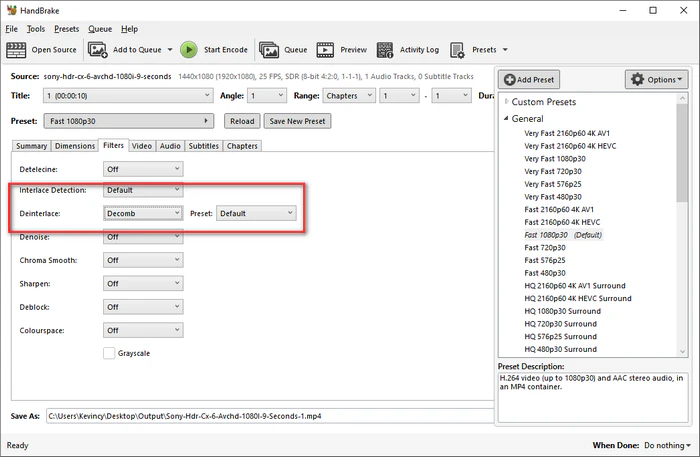
Video Deinterlace in HandBrake
Q1. Should I deinterlace every video?
No. Deinterlace only when the source is actually interlaced or shows combing artifacts during motion. Applying a deinterlacing filter to progressive footage can reduce sharpness without providing a benefit.
Q2. Does deinterlacing improve video quality?
Deinterlacing does not create new detail or make a low-quality video truly higher resolution. Its purpose is to reconstruct progressive frames and reduce interlacing artifacts so the footage displays more cleanly on progressive screens. The final quality depends on the source and the deinterlacing algorithm.
Q3. Can VLC permanently remove interlacing from a video?
The VLC method described above is for playback and leaves the source file unchanged. If you need a portable progressive copy that stays deinterlaced in other players or devices, create a new file with a converter or transcoder such as Method 1 or 3.

Perfectly convert your standard resolution resources to higher definition levels and free download YouTube to your gadgets.





Kevincy joined the WonderFox team in 2014 and has been a senior columnist ever since. With over two decades of experience in the video editing industry, he shares tutorials, tips, and how-to guides on video/audio processing and personal DVD backups. Family-oriented and passionate about helping others, he is dedicated to making video and audio processing easier for readers.


Product line: DVD Software | Video Software | Watermark Software | GIF software | Office Software
Featured product: Free DVD Ripper | Free Video Converter | Video Converter | Free HD Video ConverterService: Submit A Ticket | Retrieve Key | Order support | Product Support | Money Back Guarantee | 24 Hours Service
Terms of use: Refund Policy | License Policy | FAQ

Store | Download | About | Contact | Support | Privacy
Copyright © 2009-2026 WonderFox Soft, Inc. All Rights Reserved.