Free Download
Change Video Resolution for Playback, Sharing, and Smaller Files
AuthorRecommended by the author

SoftwareHow to & Tips

Video FormatsConvert Video

Resources

How to Change Video Resolution: 4 Easy Ways

Author: Kevincy by Kevincy

Updated on Aug 11, 2026

Changing video resolution can help a video fit a device or platform requirement, reduce storage and upload demands, or create a smaller version for sharing. This guide covers four practical methods for MP4, MKV, MOV, AVI, and other common video files, and explains what changing resolution can and cannot do for picture quality.


For the detailed Windows method, download the handy video resolution converter below:

Why Change Video Resolution?

A higher resolution is not always the best choice. You may need to downscale a 8K, 4K or 1080p video for an older TV, phone, presentation, messaging app, or upload limit. You may also need a specific frame size required by a website or editing workflow. Lowering resolution can help reduce file size, although the final size also depends on bitrate, codec, frame rate, audio, and video length. Upscaling can be useful when a platform or workflow requires larger dimensions, but it does not recreate detail that is missing from the source.

How to Change Video Resolution with Minimal Quality Loss

Changing the pixel dimensions of a video requires scaling, and in normal converter workflows the video is re-encoded. That means a perfectly lossless result should not be expected. The practical goal is to avoid visible quality loss by choosing a sensible target resolution, preserving the aspect ratio, and using appropriate encoding settings.

On Windows, WonderFox HD Video Converter Factory Pro offers a straightforward way to resize videos from higher to lower resolutions or vice versa. It also includes picture-enhancement and sharpening options, but these can only improve perceived clarity; they cannot restore fine detail that was never present in a low-resolution source.


The software handles common formats such as MP4, MKV, MOV, AVI, WebM, and more. Now, get this tool and follow the steps below.
Best Program to Change Video Resolution
HD Video Converter Factory Pro
  • 1. Change video resolution to SD, HD, FHD, 2K, 4K, 8K, and more.
  • 2. Compress large files while preserving quality.
  • 3. Convert video to 500+ formats and device presets.
  • 4. Download online video and audio from supported sites.
  • 5. Trim, merge, crop, rotate, flip, and watermark video at will.
  • 6. Record screen activity, gameplay, webinars, and audio.
  • 7. Make animated GIFs from video or image sequence with ease.
  • 8. Batch mode and hardware acceleration support.
Download Free Download
Product Page Product Page
Compatible with Windows 11, 10, 8.1, 8, 7 Windows 11/10/8.1/8/7, 100% Clean!
Change Video Resolution with HD Video Converter Factory Pro

Add or Download Video Files

Before starting, downloaddownload HD Video Converter Factory Pro and install it on your PC.

Step 1. Import the files into the video resolution converter

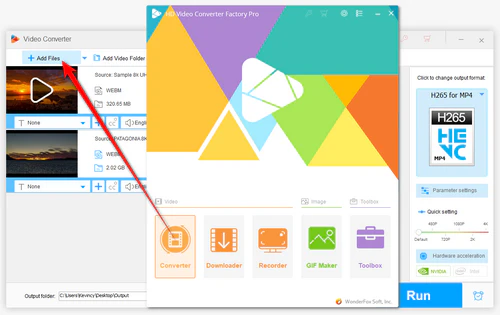
Open the software and select "Converter". Click "Add Files" or "Add Video Folder" to import the source, or drag video files directly into the window. Batch mode can process up to 10 files at a time.

Select an Output Format

Step 2. Select a desired output format

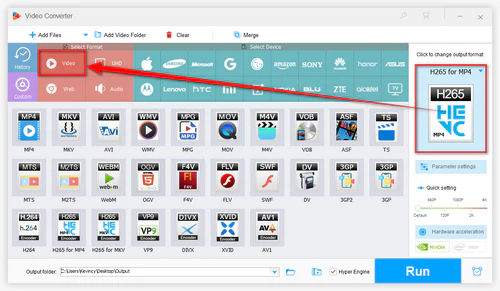
Click “Output Format” on the right and choose the format or device profile you need.

If you only want to resize the video, you can keep the same container format, such as MP4 to MP4.

Change Resolution for Video Files

Step 3. Increase or decrease video resolution

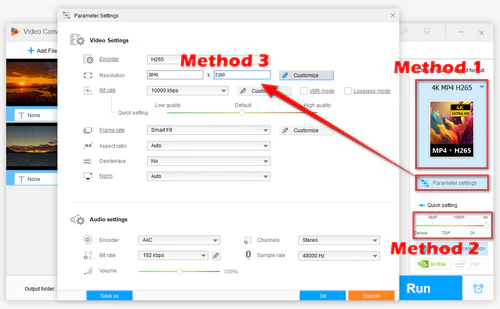
There are three convenient ways to set the output resolution.

1. Choose a preset that already matches the resolution you need, 2K, 4K, or 8K.

2. Use the Quick Setting resolution slider below the output format area to scale the video up or down.

3. Click "Parameter settings", open the Resolution menu, and select a fixed value or enter a custom width and height. Keep the source aspect ratio unless you intentionally want to crop or reshape the picture, then click OK.

Start the Conversion

Step 4. Click “Run” to export the file

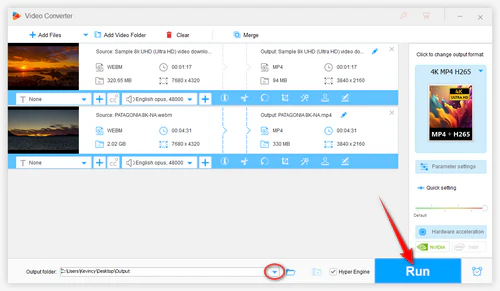
Click the inverted triangle icon at the bottom to choose an output folder. Then press “Run” to start processing.

Because resizing normally requires re-encoding, the time needed depends on video length, source resolution, codec, and your CPU/GPU.

Hot Search: 1080P to 720P | Convert Video to 360P | Convert MP4 to 4K

3 Other Ways to Change Video Resolution

If you do not need the WonderFox workflow above, the following tools can also resize common video files. They are especially useful if you already have one installed or only need a quick one-off conversion.

HandBrake Change Video Resolution

Method 2. HandBrake


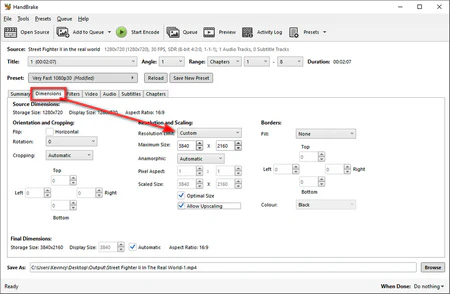
HandBrake is a free, open-source transcoder for Windows, macOS, and Linux. If you have some video processing experience, it is undoubtedly a good choice. Armed with dozens of professional features, the freeware can do more than you think.

Import the video, choose a preset, open the Dimensions tab, and set a suitable Resolution Limit or custom dimensions. Keep the display aspect ratio unless you have a specific reason to change it.

HandBrake also provides an Allow Upscaling option, but its own documentation recommends avoiding upscaling unless it serves a specific need.

Video Resolution Changer - VLC

Method 3. VLC Media Player


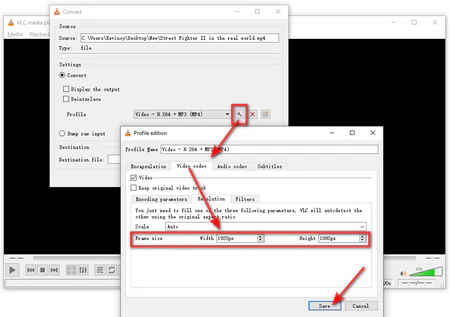
If you have VLC media player installed as your default media player, it can function as a flexible video resolution changer. Just follow the simple steps below to get the job done.

Go to Media > Convert / Save, add the video, choose a conversion profile, and click the wrench icon to edit that profile. Under the video codec settings, enter the target width and height, save the profile, choose a destination file, and start the conversion.

VLC works well for occasional resizing, although its conversion interface is less beginner-friendly than a dedicated converter.

Change Video Resolution Online

Method 4. Change Video Resolution Online


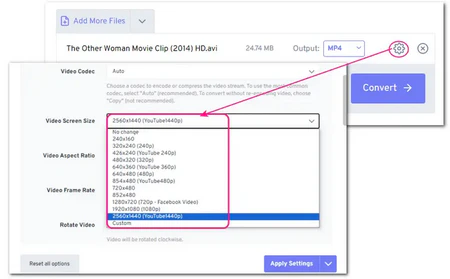
For a short or small video, a browser-based converter such as Convertio, CloudConvert, or FreeConvert can be convenient.

Upload the file, select the output format, open the settings, and choose a preset or custom width and height. Then convert and download the result.

Online tools avoid software installation, but uploads can be slow for large videos and service limits may vary, so desktop software is usually better for long, private, or high-resolution files.

Common Video Resolutions Explained

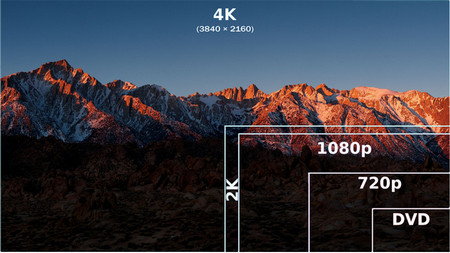
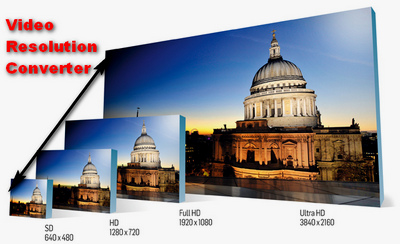
Video resolution is usually written as width × height in pixels. For example, 1280×720 means a frame is 1280 pixels wide and 720 pixels high. More pixels can preserve more spatial detail when the source contains it, but resolution alone does not determine visual quality or file size. Codec efficiency, bitrate, frame rate, source quality, and viewing distance also matter.

Main Video ResolutionMain Video Resolution

* SD: Common standard-definition sizes include 720×480 for NTSC DVD video and 720×576 for PAL DVD video. Lower web resolutions such as 640×360 are also often grouped with SD-class content.

* HD and Full HD: 1280×720 is 720p HD, while 1920×1080 is 1080p Full HD. These remain practical choices for general playback, streaming, editing, and sharing.

* UHD: 4K UHD is 3840×2160 (2160p), and 8K UHD is 7680×4320 (4320p). These resolutions provide more pixels for large displays and high-detail sources, but they also require more processing power and usually more storage or bandwidth at comparable encoding settings.

Does Changing Resolution Improve Video Quality?

Upscaling, such as converting SD video to HD video, increases the number of output pixels, but it does not add genuine detail that was never captured in the source. A 320p clip exported as 1080p or 4K is still limited by the original image information. Sharpening or enhancement may make edges look clearer, but it is not the same as restoring lost detail.

Upscaling can still make sense when a service requires a specific frame size, when you want a consistent project resolution, or when a display pipeline handles a particular size better. In those cases, use a moderate target and judge the result with a short preview before processing a long video.

Downscaling, such as 4K to 2K, 1080p, or 720p, is usually more predictable because the output uses fewer pixels than the source. It can reduce storage and processing requirements, but a smaller resolution does not automatically guarantee a smaller file: bitrate, codec, frame rate, audio settings, and duration still affect the final size.

FAQs

Q1. Can I change video resolution without losing quality?

Not completely if you actually resize the frame. Scaling changes the pixel dimensions and the video is normally re-encoded. You can keep the loss small by avoiding repeated conversions, choosing a reasonable target resolution, and using suitable quality or bitrate settings.


Q2. Why does the resized video look stretched or squashed?

The width and height probably no longer match the original aspect ratio. For a 16:9 source, common matching resolutions include 3840×2160, 1920×1080, and 1280×720. If you need a different shape, crop or add padding instead of forcing the picture into the wrong ratio.


Q3. Why is the file still large after I lower the resolution?

Resolution is only one factor in file size. A high bitrate, inefficient codec, high frame rate, long duration, or large audio stream can keep the output large. If size is your main concern, adjust bitrate or use a more efficient codec together with downscaling.


Q4. What resolution should I choose?

Match the requirements of the device, platform, or project and avoid increasing resolution unless there is a clear reason. For general use, 1080p offers a good balance on modern screens, while 720p can be useful for smaller files and older devices. Keep 4K when the source really contains 4K detail and your target can benefit from it.

Bottom Line

Changing video resolution is useful when you need a specific frame size for playback, editing, uploading, or sharing. WonderFox HD Video Converter Factory Pro offers a guided Windows workflow in this article, while HandBrake, VLC, and an online converter are practical alternatives. Whichever method you use, preserve the aspect ratio and remember that upscaling changes dimensions, not the amount of real detail in the original footage.

Free Download Free Download


Kevincy

Kevincy Berel

Kevincy joined the WonderFox team in 2014 and has been a senior columnist ever since. With over two decades of experience in the video editing industry, he shares tutorials, tips, and how-to guides on video/audio processing and personal DVD backups. Family-oriented and passionate about helping others, he is dedicated to making video and audio processing easier for readers.

Email

Kevincy

Kevincy Berel

Kevincy joined the WonderFox team in 2014 and has been a senior columnist ever since. With over two decades of experience in the video editing industry, he shares tutorials, tips, and how-to guides on video/audio processing and personal DVD backups. Family-oriented and passionate about helping others, he is dedicated to making video and audio processing easier for readers.

Email

More Related Articles

How to Change Video Format Effectively | 6 Free Solutions How to Change Aspect Ratio of a Video for Better Display Effect? How to Change Video Codec Efficiently?
How to Change Bitrate of MP4 Video Files? How to Change Audio Format of a Video Quickly? How to Change Default Audio/Subtitle Track in MKV without Remux?