Q1: Are hardcoded subtitles the same as open captions?
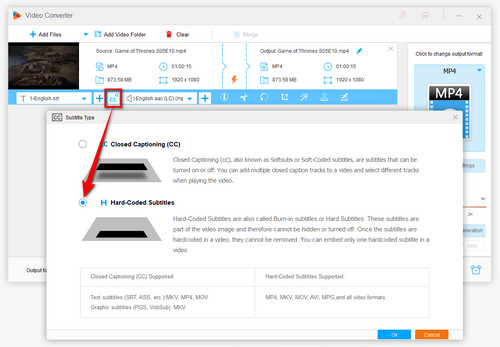
A: In most practical cases, yes. Both refer to subtitles or captions that are permanently visible on the video and cannot be turned off by the viewer.
"Open captions" is often used in accessibility, social media, and publishing contexts, while "hardcoded subtitles" is more commonly used in video conversion and editing contexts.
Q2: Can I turn off hardcoded subtitles after exporting the video?
A: No. Once subtitles are hardcoded, they become part of the video image. You cannot turn them off like a normal subtitle track.
If you want viewers to switch subtitles on or off, use closed captions or soft subtitles instead.
Q3: Can I hardcode multiple subtitle files into one video?
A: Usually, only one subtitle track can be hardcoded visibly at a time. If you burn multiple languages onto the same video, they may overlap and make the screen unreadable. If you need multiple subtitle options, consider adding them as soft subtitle tracks instead.
Q4: Why are subtitles not showing in Windows Media Player?
A: Windows Media Player, especially the older legacy version, may not load external subtitles correctly in some cases. The filename may not match, the subtitle setting may be disabled, or the subtitle format may not be supported.
You can try placing the video and subtitle file in the same folder, giving them the same filename, and turning on captions in the player. However, since WMP is no longer the best choice for modern subtitle playback, hardcoding the subtitles into the video is often a more reliable fix.
Q5: Will hardcoding subtitles reduce video quality?
A: The video needs to be encoded again, so there may be some quality change depending on the output settings. To keep good quality, choose a suitable format such as MP4/H.264 or H.265, avoid setting the bitrate too low, and keep the original resolution and frame rate when possible.
Q6: Can I burn subtitles into a video without converting/re-encoding?
A: Burning subtitles to video blends the subtitles into the video image, which causes the video to be re-encoded. If you don't want to re-encode the video, you have to add soft subtitles to the video. Check out this article How to Add Subtitles without Re-encoding the Video.



 How to & Tips
 Convert Video
 by
by 
 Free Download
 Product Page
 Windows, 100% Clean!