

 Michelle | Updated on Aug 28, 2026
When you import a video, audio or footage from cameras and smartphones into Premiere Pro, the program must decode both the container format and the underlying codec. When there's a mismatch or glitch, you may see a range of import failure messages, such as:
• The importer reported a generic error (common with MP4, MP3, MOV, AVI, etc.).
• This file has no audio or video streams (common with MP4 and MOV with variable frame rates).
• HEVC / H.265 codec missing or unsupported format (common with MKV and FLV).
• Audio not playing, missing audio track, or "error decompressing audio/video".
• The file has an unsupported compression type.
Here are the common reasons why a file import may fail:
❌ Unsupported video or audio codec (e.g., HEVC, FLV, AV1).
❌ Variable Frame Rate (VFR) footage from your phone or screen recorders.
❌ File path issues (special characters, long folder paths).
❌ Incorrect Audio Hardware driver settings in Premiere Pro.
❌ Bloated or corrupt Media Cache files.
❌ Missing system updates (e.g. Media Feature Pack on Windows N editions).
One workaround to fix the file import error in Premiere Pro (especially The importer reported a generic error) is to put the file into a different folder.
The truth is, Premiere Pro may fail to read the file path if your file is located in a deeply nested directory or in a folder with special characters (like #, %, ?, or non-English characters). Try moving the file to a simple root path such as D:\Media\ and try again.
Just like moving the file to a different folder, renaming the file may also solve the Premiere Pro file import failure. By renaming the file, you can change the file name from XYZ to X and see if it works.
If necessary, change the file extension too. For MOV files not importing into Premiere Pro, changing the file extension from .mov to .mp4 (or vice versa) works sometimes. If you don't see the file extension, go to File Explorer (Windows 10) > select View > check the box before File name extensions. Now all the files on your computer will appear with the file extension.
This solution also works with audio import failure in Premiere Pro. For example, if you can't import MP3, WAV, etc. files into Premiere Pro, you can change .mp3 to .aac, .m4a, .aiff, etc., and then see whether the file can be imported into Premiere Pro successfully.
🔔 Changing the extension doesn't equal conversion.
If your imported video has a high bitrate, uses VFR, or is encoded with an inappropriate codec such as HEVC, Premiere Pro may throw a generic error or show a blank screen. In this case, you can transcode the file to a format supported by Premiere Pro. It's recommended to use an editing format such as Apple ProRes or a universal format like H264 so that Premiere Pro can cope with them better.
WonderFox HD Video Converter Factory Pro is a professional but easy-to-use video conversion program that can convert all mainstream video/audio formats and codecs. It can easily convert files like MP4, MKV, MOV, HEVC, and MP3 to Premiere Pro supported formats in just a few clicks. Moreover, it allows you to modify the parameters, such as encoder, bitrate, frame rate, resolution, etc. to improve editing performance. Now, let's free download free download the software to convert the unsupported file for Premiere Pro.
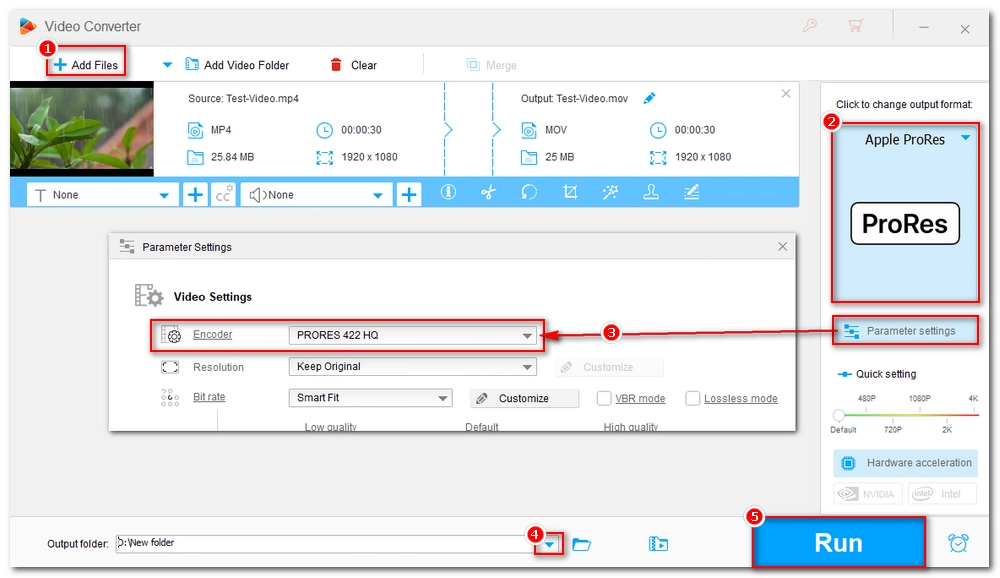
Step 1: Launch the software and open Converter. Click Add Files to add the unsupported file. You can also directly drag the file into the program interface.
Step 2: Expand the output format page on the right. Then click the Apple tab and choose Apple ProRes. It's one of the best editing formats for Premiere Pro. Alternatively, you can click the Video tab and select H264, as this format has the best compatibility across devices and software.
💡 If you've selected Apple ProRes, you can continue to open Parameter settings and choose a preferred ProRes codec in the Video Encoder drop-down menu. For example, ProRes 422 is recommended for general editing needs.
Step 3: Click the ▼ button to set an output folder. Finally, press Run to start the conversion.
💡 This program will automatically convert video to a constant frame rate that Premiere Pro supports.
After the conversion, you can try importing the converted file into Premiere Pro and see if the problem gets solved.
If you are running Windows 10 or Windows 10 N edition, Media Feature Pack may also help you fix file import failure in Premiere Pro by installing Media Player and related technologies.
Just visit the Media Feature Pack page, select your Windows edition, and then click Confirm to download the corresponding Media Feature Pack to your computer.
After the installation, try opening your media in Premiere Pro and see whether the problem persists or not.
💡 Make sure you are online and turn off the VPN so that Adobe can use the codecs to read your media file.
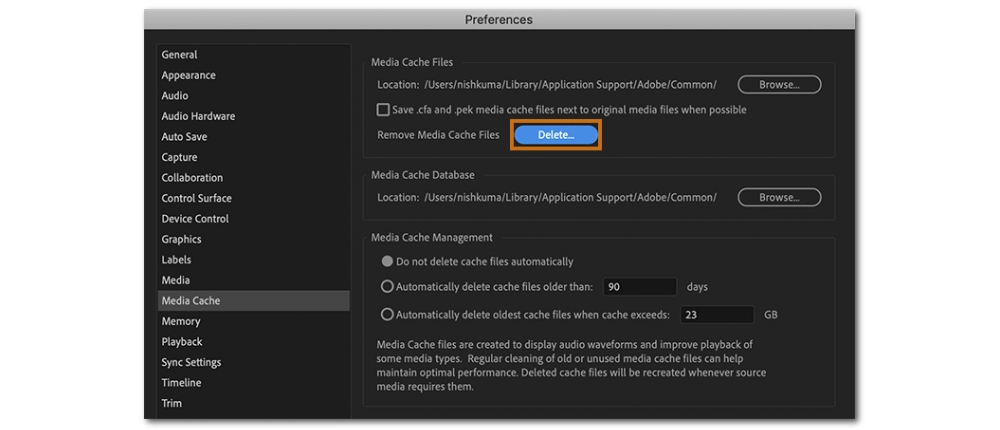
The media cache files are created to provide faster performance. But when old and unused cache files pile up, it may cause errors like file import failure in Premiere Pro. Therefore, you can try clearing or deleting the Media Cache files and see if this fixes the import problem. Here is how to delete the Media Cache in Premiere Pro.
Step 1: Open Premiere Pro.
Step 2: Go to Edit > Preferences > Media Cache. (If you opened a project, you'll need to close it before following along with this step.)
Step 3: Click the Delete button next to Remove Media Cache Files.
Step 4: Choose Delete all media cache files from the system. Don't worry, the deleted cache files will be automatically rebuilt the next time you start a project.
Step 5: Click OK and restart Premiere Pro.
Now, test if the file import failure is fixed by opening your media in Premiere Pro.
Alternatively, you can also go to the Media Cache folder and delete the cache files manually. On Windows, the default location of the Media Cache folder is \Users\username\AppData\Roaming\Adobe\Common. Just delete the whole folder and empty the trash bin.
Resetting preferences is another way to troubleshoot generic errors in Premiere Pro. It may just fix your file import error. Follow along with the instructions below to reset preferences to the factory defaults in Premiere Pro.
🔔 You should back up your preferences in advance.
Step 1: Navigate to the preferences folder on your Windows. By default, the Preferences folder is located at C:\Users\username\Documents\Adobe\Premiere Pro\version\Profile-profilename.
Step 2: Rename the folder or move it to another place.
Step 3: Open Premiere Pro. Now, a new preferences folder with factory defaults will be generated.
Check if you are using a trial version of Premiere Pro. If you are, try upgrading to a paid Creative Cloud membership so you can access the .dll files required for importing MP4 and AVCHD files.
If your Premiere Pro is experiencing some bugs, it may result in file import failure as well. You can try to uninstall the program, and then re-install it on your computer. After installation, open the software and import your media to test if the problem goes away.
Your file may be damaged or DRM-protected, which leads to file import failure in Premiere Pro. You'll need to re-download or re-gain the file so it can be imported into Premiere properly.
If the file is corrupt, you can also try to repair the file using a file repair tool such as Stellar Repair for Video.
Still having trouble? Here are more tips for fixing specific file import failures in Premiere Pro:
When you import MP4 into the Premiere Pro timeline, but only the audio or video is imported, it may be that you forgot to turn on the A1 or V1 source patching.
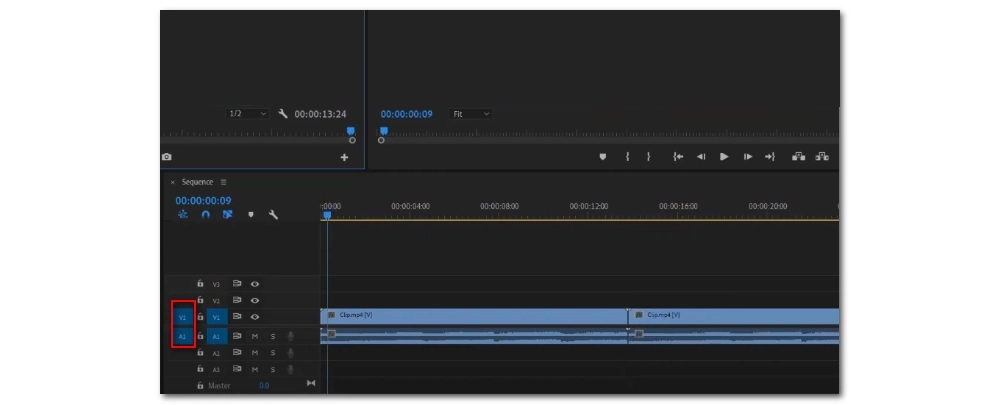
Source patching will show you the video, audio, or image to be inserted into the timeline. You need to have both A1 and V1 enabled to see the audio and video tracks. Here's how to enable them in Premiere Pro.
Step 1: Click the V1 and A1 boxes on the far left of the timeline.
Step 2: Drag the MP4 into the timeline and see if it works.
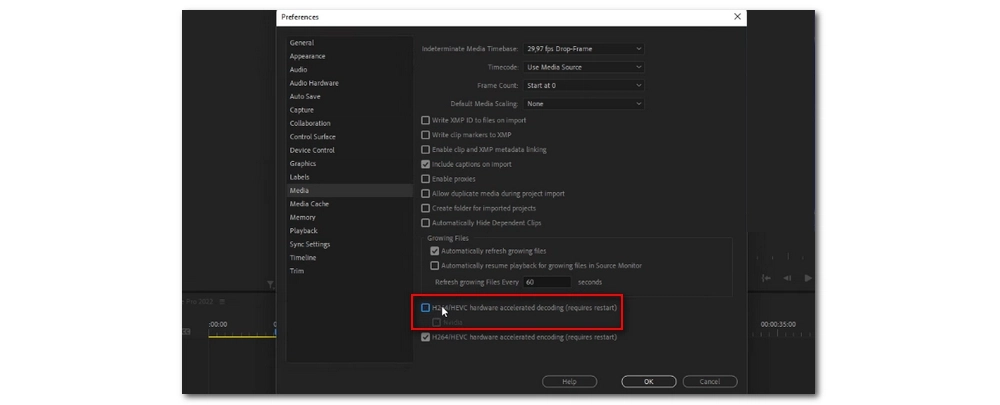
Hardware acceleration can make your rendering faster and higher quality by using the GPU. However, if your GPU is underpowered, it may cause unexpected errors. You can turn off hardware acceleration and see if that fixes Premiere Pro not importing MP4 or MKV. Here's what to do.
Step 1: Open Premiere Pro.
Step 2: Select Edit > Preferences > Media.
Step 3: Uncheck the box before H264/HEVC hardware accelerated decoding. Then click OK.
Step 4: Restart Premiere Pro and test whether the problem goes away.
If your video imports fine but you can't hear the audio, try configuring the Audio Hardware settings first.
Step 1: In Premiere Pro, go to Edit > Preferences > Audio Hardware.
Step 2: Set Default Input to No Input.
Step 3: Ensure the Default Output is set to the device you are using to hear your Premiere Pro audio, then set Latency to 200ms.
Step 4: Click OK.
If this doesn't fix the issue, you can press Ctrl + A to select all tracks, Ctrl + N to create a new sequence, and then Ctrl + V to paste the tracks into the new sequence to see if that helps.
💡 Ensure the M button in front of the audio track isn't enabled, as that's the mute button, and if it's on, you can't hear the audio.
When importing HEVC/H265 videos on Windows, Premiere Pro may display a black screen. This is because the HEVC codec is missing on Windows, and you need to install the codec extension.
Step 1: Open the Microsoft Store on your Windows PC.
Step 2: Search for HEVC Video Extensions (or HEVC Video Extensions from Device Manufacturer).
Step 3: Install the extension, restart your PC, and then restart Premiere Pro to import the HEVC file.
👉 You can also see our article How to Get HEVC Codec for Free on Windows 10/11
Videos shot with an iPhone or recorded with OBS Studio are often saved as MOV or MP4 files using variable frame rate, which Premiere Pro cannot properly handle.
To solve this problem, you can use WonderFox HD Video Converter Factory Pro to transcode the file to constant frame rate video before importing it into Premiere Pro.
If you need to import an FLV file, you can also install an FLV importer for Adobe Premiere Pro.
Moyea FLV Importer is a simple import plug-in program that allows you to import various types of FLV to Adobe Premiere without transcoding.
Step 1: Go to (http://www.video-to-flash.com/flash_video_importer/) to download the FLV Importer on your computer.
Step 2: Click it to start the setup process after finishing the downloading process.
Step 3: Launch Premiere Pro and try to import your FLV files.
I mentioned earlier changing the MP3 file extension as a possible workaround, but it doesn't always work. To properly change the format, you'll still want to use a file converter to change the MP3 into an audio format that is compatible with Premiere Pro.
For this, WonderFox HD Video Converter Factory Pro still works. Just add the MP3 file, select an output audio format (WAV, M4A or AIFF for example), then start the conversion.
Premiere Pro is an advanced and powerful video editing software that can help us get creative and productive. However, it's frustrating when you can't even import a file into the program. But don't be upset. As this kind of error is often caused by incompatible format/codec, software bugs, media cache files, etc., it is quite easy to find solutions to fix it.
In this article, I have rounded up some working solutions to this problem. Hope these could work for you. However, if none of the methods above could fix your Premiere Pro file import failure, you should contact Customer Care for more professional solutions.
That's all I want to share about how to solve file import failure in Premiere Pro. I hope this article was useful. Thanks for reading. Have a great day today!
Most of the time, the root cause for Premiere Pro import failure is unsupported codecs, variable frame rates, media cache, incorrect filename or directory paths, or wrong software settings.
The best solution is to transcode your footage to an editing friendly format such as Apple ProRes or H.264. For this purpose, you can use a video converter such as WonderFox HD Video Converter Factory Pro. The details steps are outlined above.
If a video imports without audio (or vise versa), make sure that both the V1 (video) and A1 (audio) source buttons on the far left of the timeline are enabled. If the audio track is there but silent, open Edit > Preferences > Audio Hardware and set the Default Input to No Input to fix the issue
For HEVC files, you can install the HEVC video extension. For MOV and MP4 videos, you can convert them from variable frame rate to constant frame rate. For MP3 files, you can try renaming the file extension or re-encoding it to uncompressed WAV audio.
Just move the file to a simpler root folder to rule out special path characters or long file names. Secondly, delete the Media Cache in Premiere Pro. If the problem persists, the file itself may be damaged, or it may be using an unsupported compression type, so you should download or convert the file again.

I write about multimedia topics, including video and audio conversion, compression, editing, and downloading. I joined WonderFox in 2020, and my goal is to help readers solve everyday tech problems more easily. In this guide, I have gathered several proven fixes to file import failures in Premiere Pro. Hope these methods can resolve your issue once and for all.


I write about multimedia topics, including video and audio conversion, compression, editing, and downloading. I joined WonderFox in 2020, and my goal is to help readers solve everyday tech problems more easily. In this guide, I have gathered several proven fixes to file import failures in Premiere Pro. Hope these methods can resolve your issue once and for all.

WonderFox DVD Ripper Pro
WonderFox DVD Ripper Pro is a professional DVD ripping program that can easily rip any DVD (whether homemade or commercial) to all popular formats including MP4, MKV, MOV, AVI, MP3, WAV, H264, H265, Android, iPhone, and so on. It also lets you edit and compress DVD videos efficiently. Download it to enjoy a fast and trouble-free DVD ripping experience.

Privacy Policy | Copyright © 2009-2026 WonderFox Soft, Inc.All Rights Reserved
