

Instagram can accept high-resolution videos, but it does not publish them as true 4K playback. If you upload a 4K, GoPro, or downloaded YouTube video directly, Instagram may resize, crop, and recompress it. The safer workflow is to prepare an Instagram-friendly MP4 first: 1080p, H.264 video, AAC audio, proper aspect ratio, and a reasonable bitrate. Download the dedicated HD video converter to make the video easier to upload while keeping it clear:
https://www.videoconverterfactory.com/download/hd-video-converter-pro.exehd-video-converter-pro.exe
 Kevincy | Updated on Jun 5, 2026
4K videos from phones, cameras, GoPro, DJI drones, and YouTube downloads usually look sharp before upload. But after posting to Instagram, they may become soft, blocky, or incorrectly cropped. The reason is simple: Instagram is a mobile-first platform and will process your file again for streaming, storage, and different screen layouts.
So, you can upload a 4K source file to Instagram, but viewers will not get a real 4K version. Instagram will resize and compress the video. If the source video uses an unsupported codec, a very high bitrate, variable frame rate, HEVC from a GoPro, or a wrong aspect ratio, the result can be worse, or the upload may fail completely.
The practical solution is not to chase “4K upload” blindly. Instead, prepare a clean 1080p MP4 that matches Instagram’s current format, resolution, duration, and aspect ratio requirements. This article shows you how to do that for 4K videos, GoPro footage, longer videos, very short clips, and YouTube videos you have the right to reuse.
Instagram supports different placements, and the best export settings depend on where you want to post the video. For most users, MP4 with H.264 video and AAC audio is still the most compatible choice.
✳ Format – MP4 is recommended; MOV can also work in many cases
✳ Video Codec – H.264 for best compatibility
✳ Audio Codec – AAC
✳ Resolution – 1080 x 1920 for Reels/Stories; 1080 x 1350, 1080 x 1080, or 1920 x 1080 for feed videos
✳ Aspect Ratio – 9:16 for Reels/Stories, 4:5 for portrait feed, 1:1 for square feed, 16:9 for landscape feed
✳ Bitrate – around 3,500 kbps or higher for 1080p; avoid extremely high bitrates that only make uploading slower
✳ Frame Rate – 30 fps is the safest choice; 60 fps may upload but can still be recompressed
✳ Duration – at least 3 seconds for normal video posts; Reels can be longer than old 60-second limits, but exact limits may vary by account, region, and app version
According to these settings, you should normally convert 4K content to a 1080p Instagram-ready MP4 instead of uploading a huge 4K file directly. For that, you need a powerful 4K video converter like WonderFox HD Video Converter Factory Pro. It can also help with GoPro HEVC files, YouTube videos, long clips, and videos that fail to upload because of codec or size issues.
WonderFox HD Video Converter Factory Pro can help you convert 4K, GoPro, YouTube, MOV, HEVC, and other videos to Instagram-friendly MP4 files for smoother upload. Try it out!
How to convert 4K videos for smooth upload to Instagram? Many people use WonderFox HD Video Converter Factory Pro. This software supports almost all types of video files in any resolution, including 4K and 8K. It can help you downscale 4K to 1080P, convert GoPro HEVC/H.265 to H.264 MP4, adjust aspect ratio, compress large files, and trim video length for Instagram specs.
If your source video comes from GoPro, keep the original file as clean as possible. Transfer it to your computer through a USB cable or SD card instead of repeatedly sending it through messaging apps. If the video is too dark, too shaky, or shot in a very wide angle, consider brightening, cropping, or reframing it before export. If the source is a YouTube video, use only your own video or content you have permission to reuse, then download or export it and convert it to an Instagram-friendly format.
Now, please installinstall the powerful 4K converter software and see how to perform the conversion below.
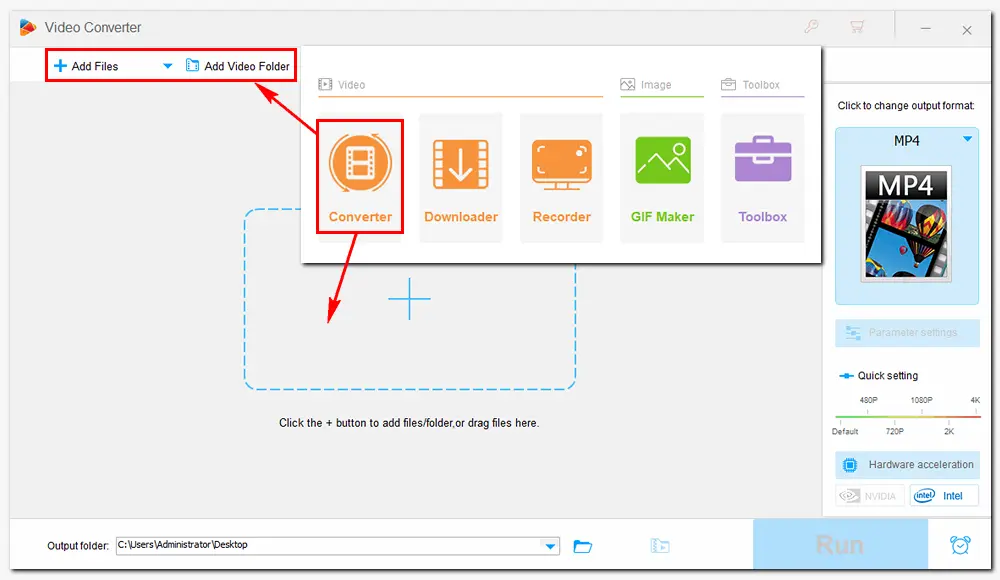
Launch HD Video Converter Factory Pro on your desktop and select Converter. Click Add Files to import your 4K video files or directly drag them into the software. Batch conversion is supported.
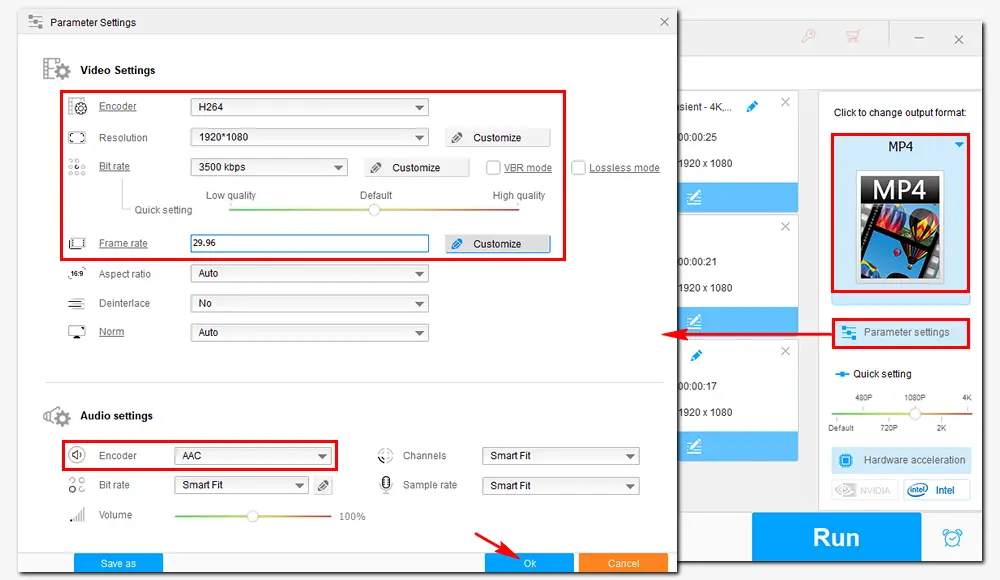
Press the format image on the right side, go to the Video tab, and select MP4 as the export profile.
Then, click Parameter settings and choose “H.264” video encoder, “AAC” audio encoder, and 30 fps.
For Reels or Stories, set the resolution to 1080*1920 if your video is vertical. For landscape feed videos, 1920*1080 is fine. You can also set the bitrate to 3500 kbps or higher according to the source quality. Press OK to save the changes.
Alternatively, you're able to go to the "Web" category and choose the "INS PC" or "INS Mobile" profile directly.
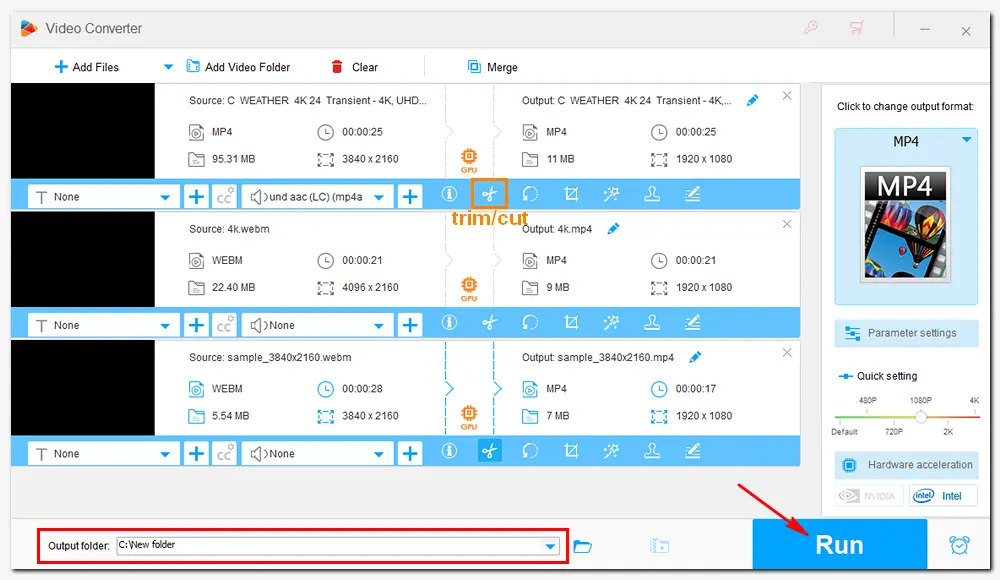
Hit the inverted triangle button at the bottom to set an output folder. Finally, press Run to start the conversion process. Once done, you can check the converted video files in your folder.
If your video is too long, click the “scissors” icon below the imported video to trim the best part or split it into several clips. If the video is too short to post, use the Merge tool to duplicate or combine clips until the duration reaches Instagram’s minimum requirement. (See how to cut a 4K video here >)
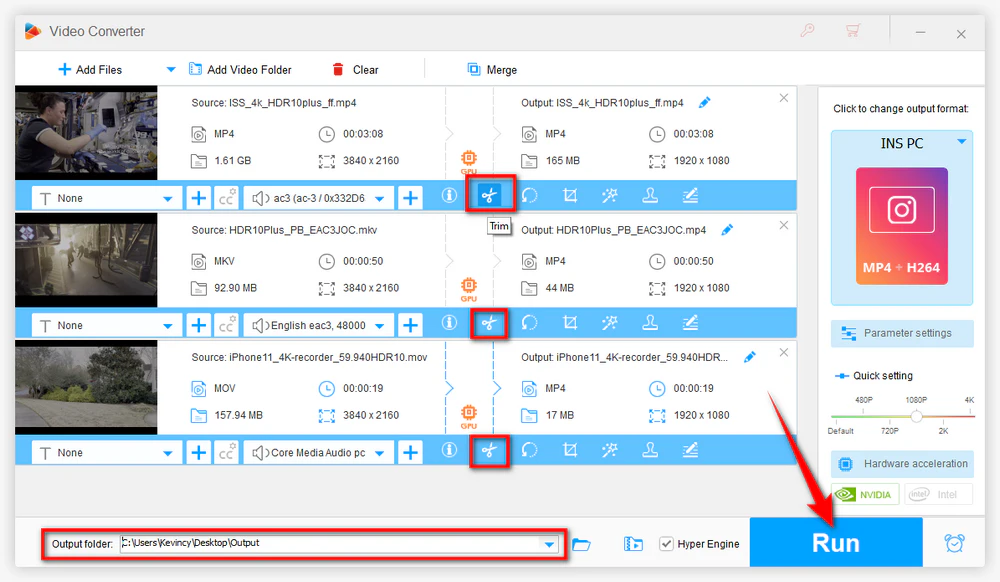
* Make one thing clear: there is no way to force Instagram to keep and play your video as true 4K. But you can convert and edit your 4K video to a supported format so it survives Instagram compression better.
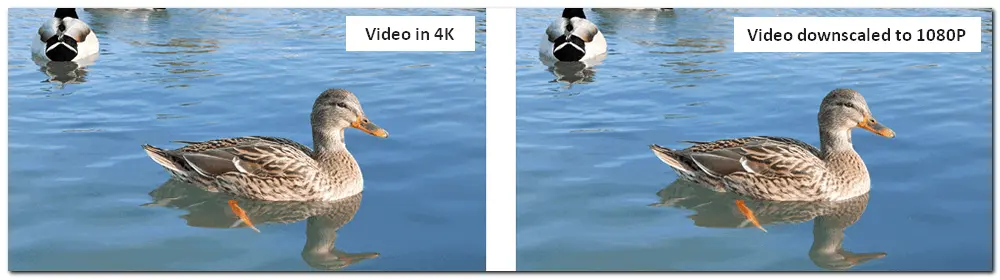
Steps to post a video on Instagram:
Step 1. Transfer the converted video to your phone. For best quality, use a USB cable, AirDrop, Nearby Share, or another lossless transfer method. Avoid sending the file through chat apps that compress video again.
Step 2. Run the Instagram app. Tap the “+” button and choose Post, Reel, or Story according to where you want the video to appear.
Step 3. Select the video from “Library” (iPhone) or “Gallery” (Android). Use Instagram’s built-in editor only for small changes, such as cover, caption, music, or simple trimming. Heavy editing is better done before upload.
Step 4. Add a caption, hashtags, location, and cover if needed. Then tap “Share” to post your video.
Tip: If you are reposting your own YouTube video, download the original file from YouTube Studio when possible, trim a highlight, convert it to vertical 9:16 or feed 4:5, and mention the full video link in your bio or caption. Do not download or repost copyrighted videos without permission.
• Convert videos for upload to Instagram, YouTube, etc.
• Batch convert 4K, GoPro, MOV, HEVC, WebM, and YouTube videos to MP4.
• Adjust resolution, codec, bitrate, frame rate, etc.
• Compress, cut, split, merge, crop, rotate, etc.
If Instagram gets stuck, says the video cannot be posted, or keeps reducing the quality badly, check the following items before trying again:
✳ Network: switch to a stable Wi-Fi connection, stop other heavy uploads, or restart the router.
✳ App status: restart Instagram and your phone, log out and log in again, update Instagram, or reinstall the app if necessary.
✳ Cache and storage: clear Instagram cache on Android, or reinstall the app on iPhone if cache-related problems continue.
✳ Data saver: turn off Instagram Data Saver and phone-level low data mode before uploading large videos.
✳ File compatibility: convert MOV, MKV, WebM, HEVC/H.265, high-frame-rate, variable-frame-rate, or very large 4K videos to MP4 H.264 + AAC.
✳ Length and size: trim long videos into highlights for Reels or feed posts, or split them into multiple parts if needed.
✳ Browser upload: if the mobile app fails, try Instagram.com on desktop; if the web upload fails, disable browser extensions and try again.
If none of these works, the issue may be on Instagram’s side or related to account/content restrictions. In that case, wait and retry later, or contact Instagram Support.
For most users, exporting a clean 1080p MP4 is better than uploading a huge 4K file directly. Instagram will compress the upload anyway, and a well-prepared 1080p file is faster to upload and less likely to fail.
GoPro videos often use HEVC, high bitrate, high frame rate, wide angle, or a landscape aspect ratio. Instagram may recompress and crop them heavily. Convert the video to H.264 MP4, choose a proper vertical or feed ratio, and keep important action near the center.
For a long video, trim the best part for a Reel or feed post. If you need to keep more content, split it into several clips and post them as a series. For a very long tutorial or vlog, post a short highlight on Instagram and guide viewers to the full version on YouTube or your website.
If the clip is too short, duplicate it, add an intro/outro, freeze the last frame, or merge it with another related clip. HD Video Converter Factory Pro can merge clips and export them as one MP4 file.
Yes, but you should only repost your own YouTube video or content you have permission to use. Download your own video from YouTube Studio when possible, trim a short highlight, convert it to an Instagram-friendly aspect ratio, and then upload it to Instagram.
You can upload a 4K video file to Instagram, but Instagram will not keep it as true 4K playback. For a clearer and more reliable result, convert the source video to an Instagram-ready MP4 first. Use H.264 video, AAC audio, 1080p resolution, the right aspect ratio, and a reasonable bitrate. If the upload still fails, check your network, app version, cache, file size, video length, and whether the content follows Instagram’s rules.

Kevincy joined the WonderFox team in 2014 and has been a senior columnist ever since. With over two decades of experience in the video editing industry, he shares tutorials, tips, and how-to guides on video/audio processing and personal DVD backups. Family-oriented and passionate about helping others, he is dedicated to making video and audio processing easier for readers.


Kevincy joined the WonderFox team in 2014 and has been a senior columnist ever since. With over two decades of experience in the video editing industry, he shares tutorials, tips, and how-to guides on video/audio processing and personal DVD backups. Family-oriented and passionate about helping others, he is dedicated to making video and audio processing easier for readers.
WonderFox HD Video Converter Factory Pro
1. Convert 4K/GoPro/YouTube videos to Instagram-friendly MP4.
2. Change resolution, aspect ratio, bitrate, frame rate, and codecs.
3. Trim long videos, split highlights, merge short clips, and crop black bars.
4. Compress large files for smoother upload.
5. Batch process multiple videos at once.
* Please use downloaded or reused videos only when you own the content or have permission.

Privacy Policy | Copyright © 2009-2026 WonderFox Soft, Inc. All Rights Reserved
