



Need to change MP4 to MOV for QuickTime, Final Cut Pro, iMovie, or an Apple-based workflow? The process is simple, but choosing the right settings matters. A MOV file is only a container, so the final quality and compatibility mainly depend on the video/audio codecs, resolution, bitrate, and frame rate you use.
Also, MP4 and MPEG-4 are often mixed up. MP4 is a container format, while MPEG-4 can refer to a group of compression standards or MPEG-4 encoded video. In daily use, an "MPEG4 video" may be an MP4 file or a video encoded with MPEG-4/H.264 in containers like M4V, 3GP, MTS, or M2TS. The method below works for common MP4 files and many MPEG-4 encoded videos.
Next, I'll show you a Windows desktop method for stable batch conversion, plus online options for small files.
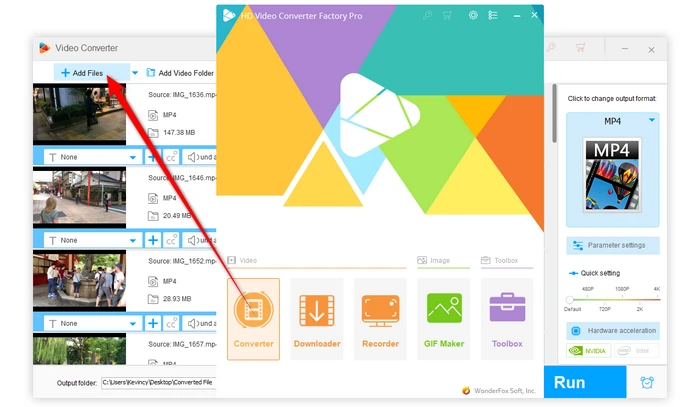
For users who need a quick but controllable way to convert MP4 or MPEG-4 encoded videos to MOV, WonderFox HD Video Converter Factory Pro is a practical choice. It accepts MP4, M4V, 3GP, MTS, M2TS, and many other video files, then exports them to MOV with customizable video and audio settings.
It is especially useful when online tools fail because of file size limits, slow uploads, privacy concerns, or unsupported codecs. You can add many files, choose MOV once, adjust output parameters if needed, and let the program finish the whole queue.
Why it fits this job 🏆:
 Download for Free
Download for Free
Download for Free
💡 The software allows for batch video conversion, so you can add multiple files and convert them to MOV together.
💡 If your file is described as MPEG-4 but does not use the .mp4 extension, add it anyway. The program will detect the container and codec automatically in most cases.
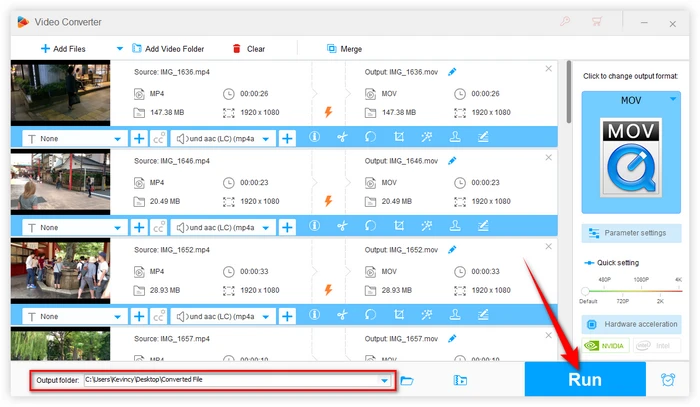
💡 Want to keep the original look? Keep the source resolution and frame rate, and avoid setting an overly low bitrate. You can also change video codec, resolution, bitrate, frame rate, volume, and other parameters for the MOV output.
💡 MOV can also contain MPEG-4 video. After selecting MOV, open "Parameter settings" and choose the "MPEG-4" encoder if this older codec is required by your device, editor, or delivery specs.
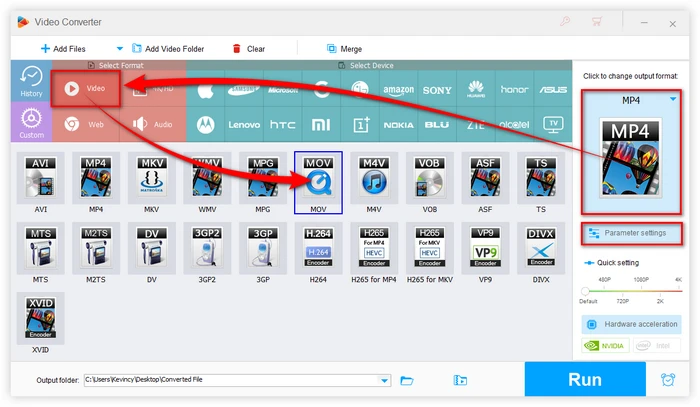
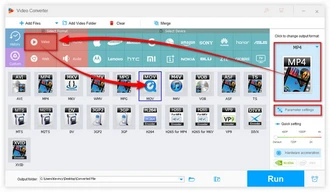
💡 Hardware acceleration (Intel QSV and Nvidia NVENC) is available for H.264 and H.265/HEVC encoding. The latest graphics card driver is recommended.
💡 If MP4 and MOV both support the source video/audio codecs, the program may use a no-transcoding conversion. In that case, it simply changes the container from MP4 to MOV and keeps the original streams intact.
💡 If your source video has multiple subtitle or audio tracks, select the needed track in the "Subtitles" or "Audio" menu before conversion, so the MOV output contains the right one.
 Download for Free
Download for Free
Download for Free
If you only have one or two small, non-private videos, an online video converter can also help convert MP4 to MOV without installing software. Upload the file, select MOV as the output format, adjust codec settings if available, and download the converted file.
Some commonly used options include:
Online tools are convenient, but they are not always the best choice for large MP4/MPEG-4 files, private footage, unstable network conditions, or batch conversion. They may also have upload limits, waiting queues, ads, or fewer output codec choices. For long videos, 4K files, or multiple files, a desktop converter is usually more reliable.
MP4 and MOV are both container formats. A container holds video, audio, subtitles, metadata, and other data. It does not decide the quality by itself. The codec and export settings do.
Features |
MP4 |
MOV |
Type |
MPEG-4 Part 14 container format |
Apple QuickTime movie container format |
Compatibility |
Very widely supported by phones, browsers, TVs, players, and social platforms |
Works well in Apple and QuickTime-based workflows; playback still depends on the codec inside |
Typical Use |
Sharing, streaming, uploading, storing, and general playback |
Editing, Apple apps, camera/export workflows, and QuickTime delivery |
Quality & File Size |
Depends on codec, bitrate, resolution, and frame rate |
Also depends on codec and settings; MOV is not automatically higher quality |
Common Codecs |
H.264, H.265/HEVC, MPEG-4, AAC, MP3, etc. |
H.264, H.265/HEVC, ProRes, MPEG-4, DNxHR, AAC, PCM, etc. |
Metadata |
Good for common metadata and online distribution |
Often preferred when QuickTime metadata, timecode, or editing data matters |
Best Choice |
Choose MP4 when you need maximum playback and sharing compatibility |
Choose MOV when your editor, client, or Apple workflow specifically needs it |
A: Not exactly. MP4 is a container format. MPEG-4 is a set of video/audio compression standards, and people may also use "MPEG4" to describe a video encoded with MPEG-4 or H.264. In practice, many MPEG-4 videos are stored in MP4, M4V, 3GP, MTS, or M2TS containers.
A: The most common reasons are QuickTime compatibility, Final Cut Pro or iMovie editing, Apple-based delivery requirements, or a project/client request for a .mov file. If your MP4 already plays and edits well, you may not need to convert it.
A: If the conversion re-encodes the video, some quality loss is possible. To keep it minimal, keep the original resolution and frame rate, use a reasonable bitrate, and avoid repeated conversions. If you only change the container without re-encoding, quality can remain unchanged, but this depends on whether the tool supports remuxing and whether the original codecs are valid in MOV.
A: For general QuickTime playback, MOV with H.264 video and AAC audio is a safe choice. For editing in Final Cut Pro or other professional workflows, choose an Apple ProRes profile from the "Apple" tab. Although less common today, MOV can also use MPEG-4 video. After choosing MOV, open "Parameter settings" and select the "MPEG-4" encoder if your device, editor, or delivery specs require it. If the source codecs are already compatible with MOV, a no-transcoding container change can keep the original quality.
A: Yes. Free HD Video Converter FactoryFree HD Video Converter Factory can convert common video files to MOV. HandBrake 1.11.0 and later also supports MOV output, though it is more suitable for users who are comfortable with more detailed encoding options. For batch conversion and more flexible settings, HD Video Converter Factory Pro is easier for most beginners.
A: Yes. WonderFox HD Video Converter Factory Pro supports merging multiple MP4 files into one MOV during conversion. To make the MOV smaller, you can use H.264, lower the bitrate, reduce the resolution, or use the built-in compression tools. Just avoid over-compressing important footage.
That’s how to convert MP4/MPEG-4 to MOV. For quick one-off files, an online converter can be enough. For large videos, private files, batch conversion, or custom output settings, WonderFox HD Video Converter Factory Pro gives you more control and a smoother workflow. Choose MOV only when you actually need it for playback, editing, or delivery; otherwise, MP4 is still the more universal format for everyday use.

Kevincy joined the WonderFox team in 2014 and has been a senior columnist ever since. With over two decades of experience in the video editing industry, he shares tutorials, tips, and how-to guides on video/audio processing and personal DVD backups. Family-oriented and passionate about helping others, he is dedicated to making video and audio processing easier for readers.


Kevincy joined the WonderFox team in 2014 and has been a senior columnist ever since. With over two decades of experience in the video editing industry, he shares tutorials, tips, and how-to guides on video/audio processing and personal DVD backups. Family-oriented and passionate about helping others, he is dedicated to making video and audio processing easier for readers.

Terms and Conditions | Privacy Policy | License Agreement | Copyright © 2009-2026 WonderFox Soft, Inc. All Rights Reserved