Q1. Can you convert frame rate?
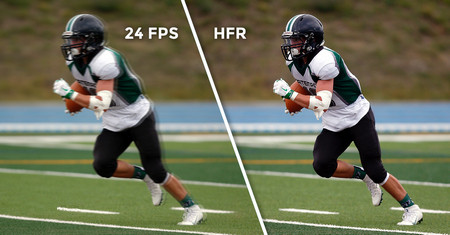
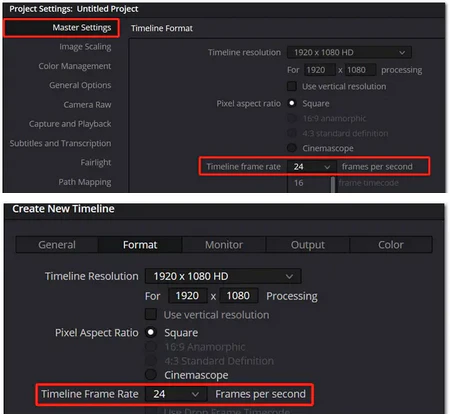
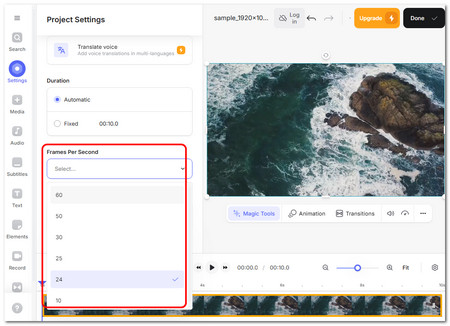
Yes. With a frame rate converter, you can adjust the frame rate of a video to 24, 25, 30, 50, 60, 120, or a custom value. But note that changing FPS does not automatically improve real quality. Lowering FPS drops frames, while increasing FPS usually duplicates or interpolates frames.
Q2. What's the best frame rate for YouTube?
There is no single best frame rate for every YouTube video. 24 or 30 FPS is enough for most tutorials, vlogs, and talking-head videos. 60 FPS is better for gameplay, sports, and fast-motion content. The safest choice is to upload the video at the same frame rate you recorded or edited it in, unless you have a clear reason to convert it.
Q3. Can I convert 60fps or 120fps to 24fps without slow motion?
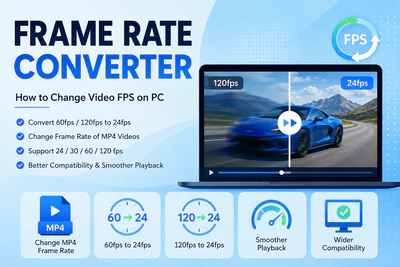
Yes. If you set the output frame rate to 24fps in a converter, the video will keep normal speed and extra frames will be removed. This is useful for file size reduction, compatibility, or a movie-like look. If you want slow motion, use a video editor to slow down the high-fps footage on a lower-fps timeline.
Q4. Can I convert 30fps to 60fps?
Yes, you can. However, converting 30 fps to 60 fps usually repeats frames unless the tool uses frame interpolation. The output file may show 60fps, but it will not contain the same real motion detail as a video originally recorded at 60fps.
Q5. Does changing MP4 frame rate reduce file size?
It can, especially when you reduce a high frame rate such as 60fps or 120fps to 30fps or 24fps. But file size also depends on resolution, codec, bitrate, duration, and audio settings. For better compression, adjust the bitrate or use a more efficient codec together with frame rate conversion.
Q6. Should I use CFR or VFR?
For editing, uploading, and device compatibility, CFR is usually safer. VFR can be fine for casual playback, but it may cause audio sync issues or timeline lag in some editors. If your video behaves strangely, try converting it to a constant frame rate.
Q7. Why can 30fps to 24fps look choppy?
A same-speed 30fps-to-24fps conversion has to discard some temporal information, so motion-heavy scenes can show more judder than the original. This is most noticeable with fast camera pans or action. Interpolation can sometimes smooth the cadence, but it may introduce visual artifacts. If 24fps is not required, keeping the original 30fps avoids this extra conversion.




 How to & Tips
 Convert Video