Convert M4A Files with the Best Converter for Any-device Playback.
 Recommended by the authorRecommended by the author
 How to & Tips
 Convert Video

by Kevincy
Updated on May 27, 2026
M4A is a common audio format used by Apple Music, iTunes, voice recordings, podcasts, and many downloaded audio files. In most cases, Windows 10 and Windows 11 can open M4A files directly with the built-in Media Player or Windows Media Player. But sometimes, you may still run into problems like “file format not supported,” no sound, failed import, or the file simply refusing to play.
This guide explains why M4A playback fails and introduces three simple ways to play M4A on Windows. Some methods can also help when your M4A files won’t play on iPhone, Android, or other devices.
M4A stands for MPEG-4 Audio. It is an audio file container that usually stores AAC or ALAC (Apple Lossless Audio Codec) audio streams. Compared with MP3, AAC-based M4A files can often deliver good sound quality at a smaller file size, while ALAC-based M4A files keep lossless audio quality.
M4A is widely used in Apple’s ecosystem, including music, audiobooks, voice memos, podcasts, and other audio files. Although it is closely associated with Apple devices, modern Windows PCs can also play many M4A files without extra tools.
Can Windows Media Player play M4A?
Yes. Recent versions of Windows Media Player and the newer Media Player app on Windows 10/11 can play many common M4A files.
However, M4A is only a container. The actual audio inside may be encoded with AAC, ALAC, or another codec. If the file is corrupted, downloaded incompletely, renamed from another format, or created with non-standard settings, Windows may still fail to recognize it.
If your M4A file won’t play on Windows, try the following three methods one by one:
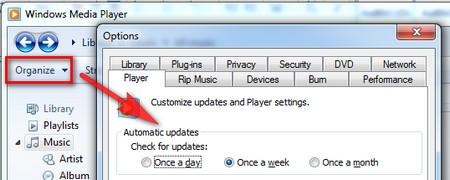 Fix Windows Media Player M4A Playback Issue
 Method 1. Update – Turn Windows Media Player into a Windows M4A Player
If you are using an older version of Windows Media Player, update it first. This is the easiest fix when the issue is caused by outdated playback components.
Launch Windows Media Player > “Organize” > “Options” > “Player” tab > set “Check for updates” to once a day/once a week/once a month.
If you are on Windows 11, you can also try opening the file with the newer Media Player app instead of the legacy Windows Media Player.
Method 2. Manually Install a Proper Codec Pack
If updating the player doesn’t help, you can install a trusted codec pack such as K-Lite Codec Pack. This may help Windows recognize more audio and video codecs. However, this method is not always necessary on Windows 10/11 because many common audio codecs are already supported. Also, avoid installing codec packs from unknown websites.
Step 1. Navigate to https://www.codecguide.com/download_kl.htm
Step 2. Locate Basic pack, click “Download Basic” to download.
Step 3. Remove old or suspicious codec packs if there are any. Launch the K-Lite Codec Pack .exe to install it.
Now play M4A files on Windows Media Player to see if it works. If the file still fails to open, converting it to a more compatible format is usually more reliable.
If your M4A file won’t play in Windows Media Player, on iPhone, or on another device, converting it to a more widely supported format is often the most practical solution.
WonderFox Free HD Video Converter Factory is a handy tool that can convert M4A to MP3, AAC, WAV, WMA, FLAC, and other common audio formats. It supports 500+ output presets and includes a built-in media player, so you can preview the file before conversion. This is useful when you are not sure whether the problem comes from the player or from the file itself.
For Windows playback, MP3 is usually the safest choice. For iPhone playback, AAC, MP3, ALAC, WAV, or AIFF can be selected depending on your needs. For keeping better compatibility across phones, computers, car players, and portable devices, MP3 is still the easiest option.
Freely Play M4A Files on Any Device
The best solution to fix stubborn M4A compatibility issues is to convert M4A to a more universal format like MP3 or AAC. WonderFox Free HD Video Converter Factory allows you to convert M4A to 500+ formats and devices, helping you play M4A files on Windows, iPhone, Android, car players, and more. 100% CLEAN, FREE, and EASY TO USE.


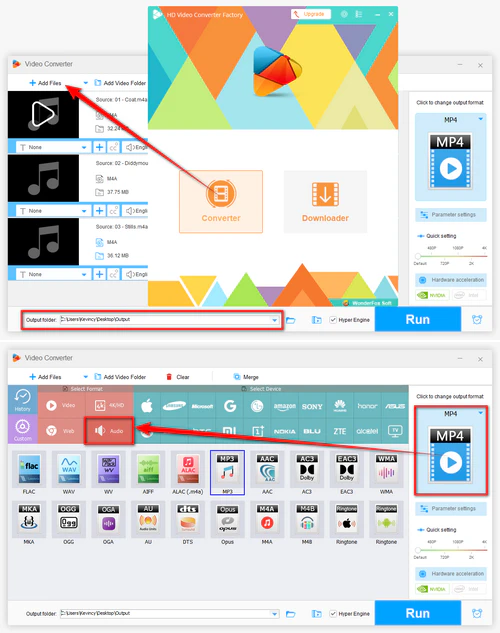
Before starting, please free downloadfree download the software.
Launch WonderFox Free HD Video Converter Factory. Open Converter and click “+Add Files” to add M4A files. Then click the inverted triangle icon at the bottom of the interface to choose an output folder.
*Tips: You can move your cursor over the file you import and click the Preview button to directly play the M4A file.
Click the format image on the right side of the interface to enter the output format library. For Windows playback, you can choose MP3 for general compatibility, WMA for older Windows-based devices, WAV for uncompressed audio, or AAC for good quality with smaller file size.
If you want to play the file on iPhone, you can choose AAC, MP3, ALAC, WAV, or AIFF according to your needs. If you simply want the audio to play on as many devices as possible, choose MP3.
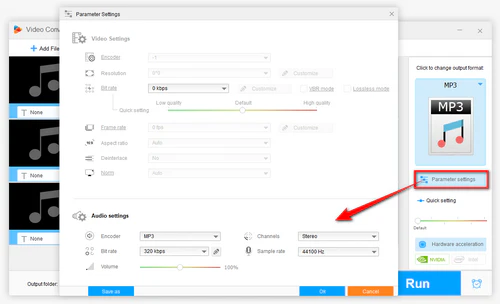
If needed, click “Parameter settings” to customize your output files, you can convert stereo to mono, change audio bitrate, convert audio sample rate, etc.
When everything is set, click “Run” button to start the conversion.
Hot Posts: Cut Video in Windows Media Player | Media Player Rotate Videos | Rip DVD with Windows Media Player
If you don’t want to convert the file, another simple solution is to try a different media player. Many Windows Media Player alternatives have broader format support than the default player and can open M4A files without extra setup.
VLC Media Player is one of the easiest choices for Windows users. It supports many audio and video formats out of the box and does not require extra codecs in most cases. If Windows Media Player fails, VLC is usually worth trying first.
MusicBee is a good choice if you have a large local music library. It supports M4A, MP3, AAC, FLAC, OGG, and more. It also offers playlist management, tagging, and library organization.
Foobar2000 is lightweight and highly customizable. It is suitable for users who want a clean audio player with advanced tagging, ReplayGain, and gapless playback support.
For Mac users, the built-in Music app and QuickTime Player can usually open M4A files. If you need a third-party option, Elmedia Player and OmniPlayer are also worth considering. For iPhone and Android users, VLC and MX Player are common choices for playing M4A and many other audio/video formats.
If the same file cannot be opened by several different players, the file may be damaged or encoded in an unusual way. In that case, try converting it to MP3 or AAC with the method above.
Q1. Why won’t my M4A file play on Windows?
Windows 10/11 can usually play M4A files. If one file fails, it may be corrupted, downloaded incompletely, renamed from another format, encoded with an unsupported codec, or opened with an outdated player. Try another player first. If it still fails, convert the file to MP3 or AAC.
Q2. Can iPhone play M4A files?
Yes. iPhone generally supports M4A files, especially AAC and ALAC audio. But some M4A files may still fail to play if they are damaged, encoded unusually, or not transferred correctly. In that case, you can convert the file to AAC, MP3, ALAC, WAV, or AIFF and transfer it again.
Q3. What is the best M4A player for Windows?
For most users, VLC is the easiest option because it supports many formats without extra setup. MusicBee is better for managing a music library, while Foobar2000 is a good lightweight choice for advanced audio users.
Q4. Should I convert M4A to MP3?
If your M4A files already play normally, you don’t need to convert them. But if you want better compatibility with older players, car stereos, Android devices, or Windows apps, MP3 is usually the safest format. Keep in mind that converting from one lossy format to another may not improve audio quality; it mainly improves compatibility.
At last...
M4A is not a rare format, and most modern devices can play it without trouble. If your M4A file won’t play on Windows, start by updating your player or trying the newer Media Player app. If that does not work, try VLC, MusicBee, or Foobar2000.
But if the file still fails to open, or if you want to play it on iPhone, Android, car stereo, or an older device, converting M4A to MP3, AAC, or another compatible format is usually the most reliable fix. WonderFox Free HD Video Converter Factory can help you convert and preview M4A files in a simple way, making the audio easier to play across different devices.


Kevincy joined the WonderFox team in 2014 and has been a senior columnist ever since. With over two decades of experience in the video editing industry, he shares tutorials, tips, and how-to guides on video/audio processing and personal DVD backups. Family-oriented and passionate about helping others, he is dedicated to making video and audio processing easier for readers.


Kevincy joined the WonderFox team in 2014 and has been a senior columnist ever since. With over two decades of experience in the video editing industry, he shares tutorials, tips, and how-to guides on video/audio processing and personal DVD backups. Family-oriented and passionate about helping others, he is dedicated to making video and audio processing easier for readers.
Play DVD Movies with Windows Media Player

WonderFox DVD Ripper Pro
1. Rip your DVD contents in digital form with original quality preserved
2. Decrypt/bypass almost any DVD copy protection
3. Convert DVD to 300+ formats and devices, including Windows Media Player
4. Compress a large DVD video to a smaller one;
5. Basic editing features to cut, crop DVD videos;
* Please DO NOT use it to rip any copy-protected DVDs for commercial purposes.