

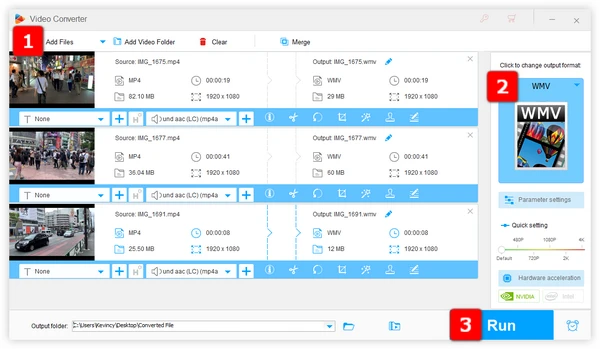


MP4 is one of the most popular video formats with broad compatibility. But not every MP4 file is the same. Some MP4 videos use codecs, profiles, or parameters that older Windows Media Player, apps, or certain editing programs cannot decode properly.
In this case, converting MP4 to WMV can make the video easier to open in Windows-based workflows, especially when you need a WMV file for legacy software, local playback, or a specific sharing requirement. Below are several practical MP4-to-WMV conversion methods for different needs.
For a quick and stable conversion, WonderFox HD Video Converter Factory Pro is our top pick. It provides a configured WMV profile, supports batch conversion, and also lets you adjust video codec, bitrate, resolution, frame rate, and audio settings when needed.
It is also more than a simple format converter. You can use it to trim, merge, crop, rotate, compress, download, record, and process videos in one place. The straightforward GUI makes it easy to navigate even for less tech-savvy users.
 Download for Free
Download for Free
Download for Free
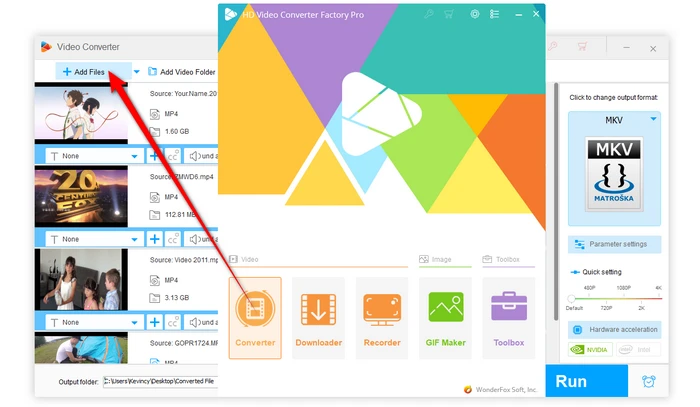
DownloadDownload, install, and run HD Video Converter Factory Pro, go to "Converter", and click "Add Files" to import the MP4 files you want to convert. A simple drag-and-drop is also allowed.
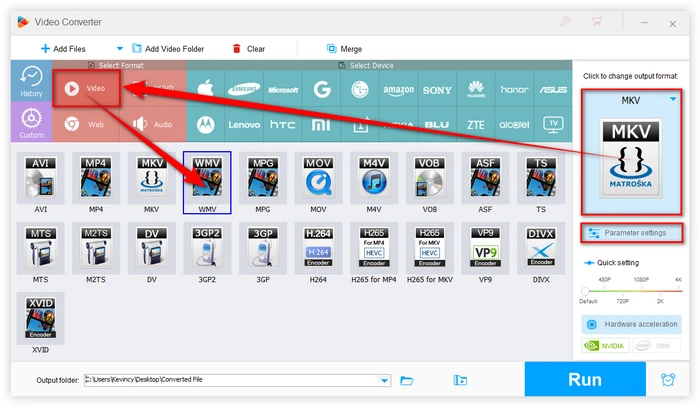
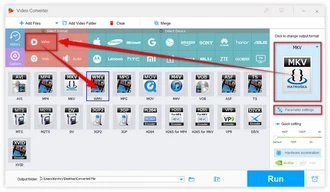
Open the output format library on the right side, go to the "Video" category, and select "WMV" as the output profile.
Tips. There are more than 500 pre-configured output presets for different devices and purposes. You can also open the "Parameter settings" window to change video codec, resolution, bitrate, frame rate, audio encoder, and other settings for more control over the WMV output.
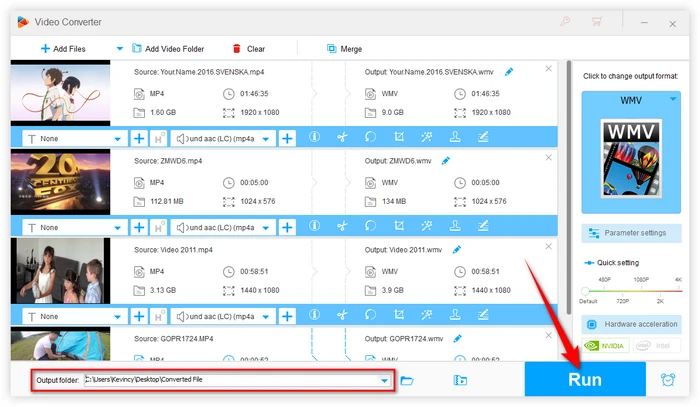
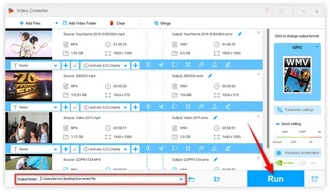
Specify an output folder, and click "Run" to start converting your MP4 files to WMV in bulk. When the process is complete, open the output folder and check the converted WMV files.
 Download for Free
Download for Free
Download for Free
Need a free way to convert MP4 to WMV? The following tools can help. They are useful for occasional conversion, but some may be slower, less intuitive, or limited in batch processing compared with the Pro method above.
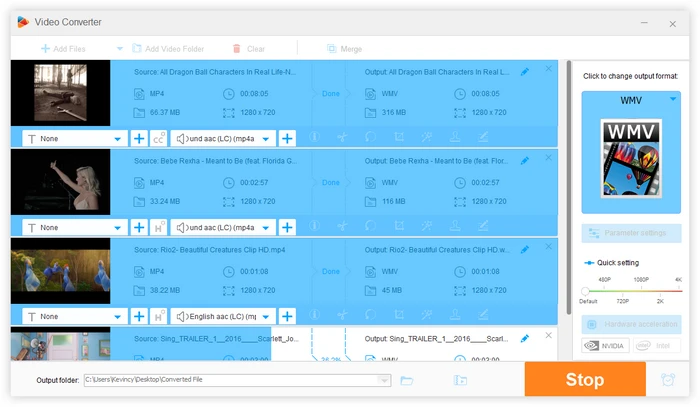
This is a free and simplified version of WonderFox HD Video Converter Factory Pro. It has the same basic conversion workflow and includes a ready-made WMV output profile, but it has limitations on simultaneous conversion and hardware acceleration.
For a single MP4 file or a small number of videos, it is still an excellent free MP4-to-WMV converter without watermark. The steps are similar: open Converter, add your MP4 file, choose WMV under the Video tab, set an output folder, and click Run.
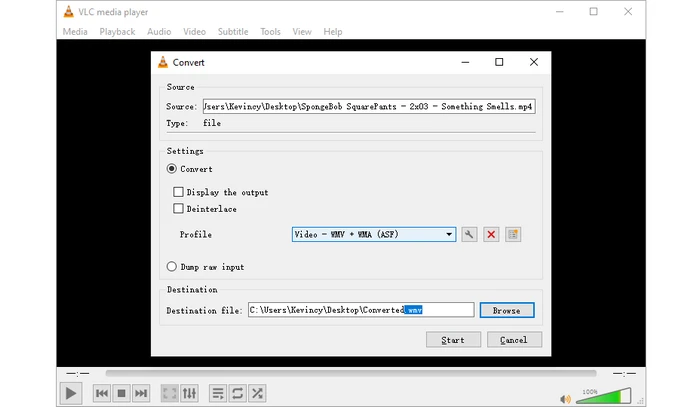
The popular VLC is not only a versatile media player, but also has basic conversion capability. It can convert MP4 to WMV/ASF for occasional use, though the process is less direct than using a dedicated converter.
Note. VLC is handy for one-off conversions, but it may be confusing for beginners and is not ideal for large batch jobs. If the converted WMV has no audio, edit the selected profile and enable Keep original audio track. You can also try another compatible audio codec or adjust the audio bitrate and sample rate, then convert again.
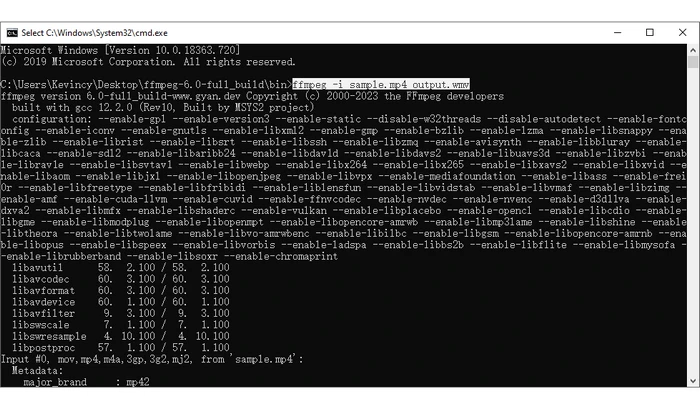
FFmpeg is a free, open-source command line tool for converting video and audio between formats. With the right command, you can convert MP4 files to WMV, but it has a steep learning curve for users who are not familiar with command lines.
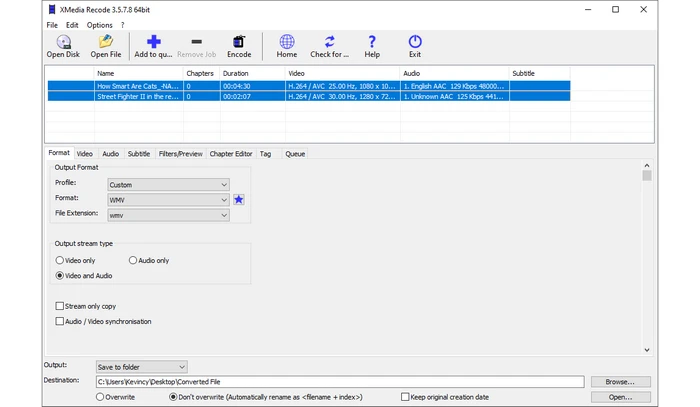
XMedia Recode is a free yet functional video transcoding program for Windows with tons of output formats. The interface is outdated but it can handle MP4 to WMV conversions fairly well. Follow these instructions:
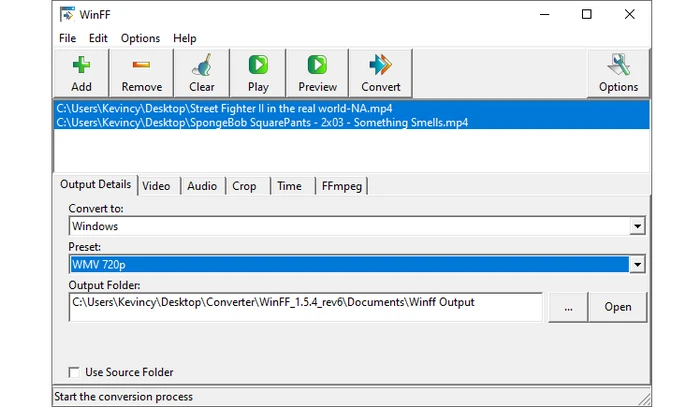
WinFF is an older open source video converter for Windows and Linux. It relies on FFmpeg and can still convert MP4 to WMV on compatible systems, but its development has been inactive for years. Treat it as a legacy option; if you want a maintained graphical converter, XMedia Recode above is a better choice. Here's the basic WinFF workflow:
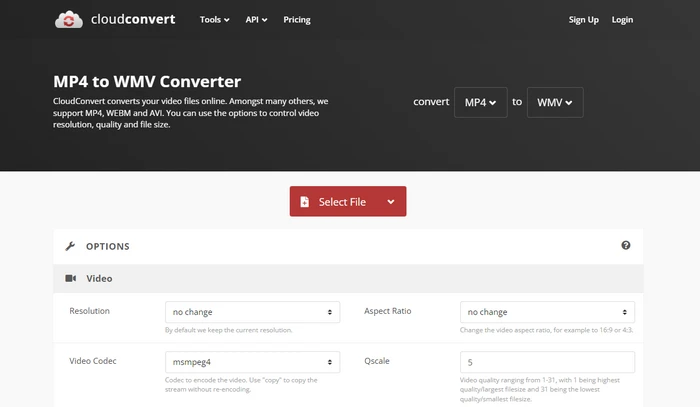
For quick one-off conversions, some free online video converter tools can convert MP4 to WMV right in your browser without installing software. Examples include but are not limited to:
To use them, go to the website, upload your MP4 file, select WMV as the output format, and click Convert. Online tools are convenient, but they are not ideal for private videos, very large files, or unstable network connections because the file must be uploaded first.
📢 HandBrake can open MP4 files, but it still cannot export WMV. Starting with version 1.11.0, HandBrake added MOV container output, so the current HandBrake 1.11.2 can output MP4/M4V, MKV, WebM, and MOV, but not WMV. Simply renaming an output file to .wmv does not create a real WMV file, so use one of the converters above when WMV is required.
WonderFox HD Video Converter Factory Pro, a great Swiss army knife of A/V processing, works as a novice-oriented video/audio recorder, downloader, editor, compressor, converter, GIF maker, ringtone maker. Get the all-in-one app here!
Download for Free
Download for Free
A: MP4 is a container format that can store many kinds of video, audio, and subtitle streams, such as H.264/AAC or H.265/AAC. WMV usually refers to Windows Media Video files that use Microsoft video/audio technologies. MP4 is more widely used for sharing, streaming, and modern devices, while WMV is mainly useful for specific Windows-based or legacy workflows.
A: Usually not. Most MP4-to-WMV conversion involves re-encoding, so some quality loss is possible. You can reduce visible loss by using a reasonable bitrate, keeping the original resolution and frame rate when appropriate, and avoiding repeated conversions.
A: The conversion time depends on various factors, such as the number and file size of the source MP4 files, the conversion software used, and your computer's hardware. Faster processors and dedicated graphics cards can significantly speed up the conversion process.
A: No. Windows Media Player can play many media files, but it does not provide a video conversion/export feature for turning MP4 into WMV. Use a dedicated converter, VLC, FFmpeg, or another tool that can actually encode WMV files.
A: No. WMV is still not an output option in the latest version 1.11.2, so HandBrake cannot batch-convert MP4 files to WMV. Use one of the WMV-capable tools above instead.
A: Yes. Online MP4-to-WMV converters may limit file size, conversion speed, or the number of free tasks. They also require you to upload the source video, so desktop software is a safer choice for large, private, or work-related files.
For batch MP4-to-WMV conversion, quality control, and a beginner-friendly workflow, WonderFox HD Video Converter Factory Pro is the most efficient option in this guide. For occasional use, Free HD Video Converter Factory, VLC, FFmpeg, XMedia Recode, WinFF, and online tools can also help. Choose the method that best fits your file size, privacy needs, and comfort level.

Kevincy joined the WonderFox team in 2014 and has been a senior columnist ever since. With over two decades of experience in the video editing industry, he shares tutorials, tips, and how-to guides on video/audio processing and personal DVD backups. Family-oriented and passionate about helping others, he is dedicated to making video and audio processing easier for readers.


Kevincy joined the WonderFox team in 2014 and has been a senior columnist ever since. With over two decades of experience in the video editing industry, he shares tutorials, tips, and how-to guides on video/audio processing and personal DVD backups. Family-oriented and passionate about helping others, he is dedicated to making video and audio processing easier for readers.

Terms and Conditions | Privacy Policy | License Agreement | Copyright © 2009-2026 WonderFox Soft, Inc. All Rights Reserved