Need to email a recording, share audio in a messaging app, save phone storage, upload a podcast faster, or shrink a large music collection? This guide explains practical lossless and lossy compression methods without making the sound unnecessarily thin or distorted.
Feel free to download the recommended audio compressor to reduce audio size in batch: https://www.videoconverterfactory.com/download/hd-video-converter-pro.exe
Compress Large Audio Files by Audio Size Reducer
Audio files can become surprisingly large, especially when they are recorded as uncompressed PCM in WAV/AIFF, saved as lossless FLAC/ALAC, exported at high bitrates, or kept as long lectures and podcasts. Just like reducing large video file size, shrinking audio can free up device storage and make sharing much easier.
The key is to choose the right compression method. Uncompressed audio can be packed into FLAC or ALAC without changing the decoded sound, while a smaller sharing copy can be made with MP3 or AAC. An already lossy file is usually reduced by lowering bitrate, sample rate, or channels, or by trimming silent and unwanted parts.

How to reduce audio file size? The answer depends on what kind of source file you have.
Case 1: Compress uncompressed or lossless audio. For uncompressed PCM sources such as WAV and AIFF, convert to FLAC or ALAC when you need a smaller archival copy with the decoded audio preserved exactly. If you need a much smaller file for listening, uploading, emailing, or mobile storage, create a lossy MP3 or AAC copy instead. FLAC and ALAC are already losslessly compressed, so changing between lossless formats usually brings only a modest and content-dependent size difference. Once audio is converted to a lossy format, the discarded detail cannot be restored by converting it back to WAV or FLAC.
Case 2: Compress an already lossy audio file. If the source file uses MP3, AAC, OGG, WMA, or another lossy codec, converting it again will not improve quality. To make it smaller, the most direct way is to lower the audio bitrate. You can also cut audio, reduce sample rate, change stereo to mono for speech recordings, or remove unnecessary parts.
Note: M4A is a container. It may hold either lossy AAC or lossless ALAC, so check the audio codec rather than judging by the extension alone.
1. Convert uncompressed audio to FLAC or ALAC for lossless storage. This keeps the decoded audio intact and usually saves meaningful space compared with PCM WAV or AIFF, though it will not become as small as a lossy file.
2. Create a lossy copy for a much smaller file. Converting uncompressed or lossless audio to MP3 or AAC is usually the biggest space saver. MP3 offers broad compatibility, while AAC commonly provides good quality at lower bitrates.
3. Lower the bitrate. Bitrate controls how much data is used per second. A lower bitrate means a smaller file, but also less detail. For casual music, 128-192 kbps is a practical starting range. For podcasts, lectures, interviews, and voice memos, 64-96 kbps may be enough.
4. Change stereo to mono when suitable. For voice-only recordings, mono can reduce size noticeably while keeping speech clear. For music, keep stereo unless file size matters more than the listening experience.
5. Trim silence or unwanted parts. If a recording contains long pauses, mistakes, or unused intros/outros, trimming them is a clean way to reduce size without lowering the quality of the parts you keep.
6. Use online tools only for small, non-sensitive files. Online audio compressors are convenient for an occasional file, but they may have size limits, upload/download delays, ads, and privacy concerns. Desktop software is better for large files, batches, and private recordings.
WonderFox HD Video Converter Factory Pro is not only a video size compressor, but also an easy-to-use audio compressor software. It can make audio files smaller by converting formats, lowering bitrate, changing sample rate/channels, trimming audio, and processing multiple files at once.
Free Download and install this audio file compressor on your Windows PC, then let's get started.
Open the application, select "Converter", and then click "Add Files" or drag-and-drop to import your audio files. You can add MP3, AAC, M4A, WAV, FLAC, AIFF, WMA, OGG and more. Batch mode is supported, so you do not need to compress files one by one.
Besides compressing local audio files, the software can also download audio files from popular websites for personal offline use and further compression.
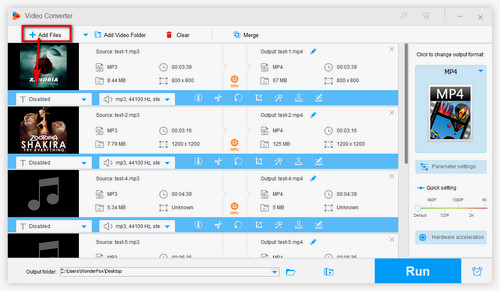
Import Audio Files You Want to Compress
Before you reduce audio file size, open the Output Format list on the right and select a format under the Audio category. For broad compatibility, choose MP3. For efficient lossy compression, choose an AAC-based M4A profile. If an M4A source contains ALAC, converting it to AAC can greatly reduce size; if it already contains AAC, keep the same codec and lower the bitrate in the next optional settings panel.
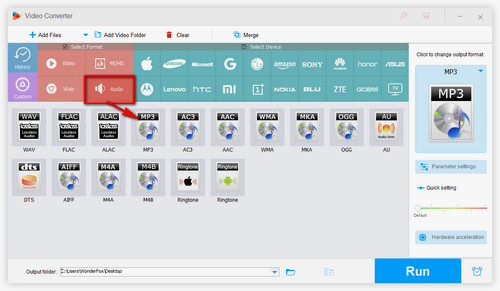
Select Output Format
Tips: For lossless sources, converting to a lossy format gives the most obvious size reduction. For already lossy files, avoid repeated conversion unless you really need a smaller file. This audio compressor also includes 500+ optimized presets for different devices and platforms.
Specify your output folder path on the bottom and hit the "Run" button to start compressing audio files.
Congrats! The whole process will be complete quickly thanks to batch conversion mode. Click "Open Folder" to find your output files, then transfer, upload, email, or stream your smaller audio files as needed.
Also Read: MP3 Compressor | Compress WAV File
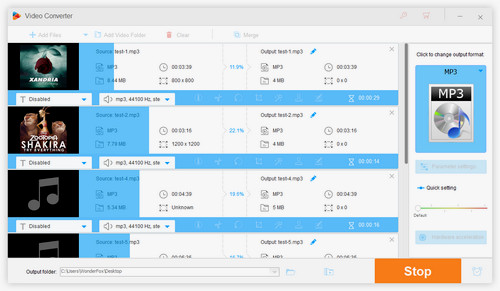
Batch Compress Audio Files
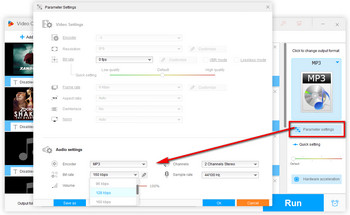
Modify Audio Parameters
Open the Parameter Settings window if you want more control. Lowering bitrate can make files smaller, but it may also reduce sound quality. For music, try 192 kbps or 128 kbps first. For speech, try 96 kbps or 64 kbps. You can also change encoder, audio channel, sample rate, and boost audio volume. If you are not familiar with audio parameters, keep the default values or test a short file first.
For music: MP3/AAC/M4A at 128-192 kbps is a good starting point for casual listening. Use a higher bitrate if you notice cymbals, vocals, or instruments becoming harsh.
For podcasts, lectures, and voice recordings: mono AAC/MP3 at 64-96 kbps often keeps speech clear while greatly reducing size. You can also cut silent parts to save more space.
For M4A files: first identify whether the file contains AAC or ALAC. For AAC-based M4A, keep AAC and lower the bitrate instead of converting through another lossy codec. For ALAC-based M4A, create an AAC or MP3 copy when you need a much smaller file.
For lossless archives: keep the original WAV/AIFF or lossless FLAC/ALAC backup if the recording is important, then create a smaller MP3 or AAC copy for daily use and sharing.
Check the real limit before compressing: Personal Gmail accounts currently allow up to 25 MB in total attachments, and Outlook.com also lists a 25 MB file attachment limit. Work, school, Exchange, and other mail systems may use different limits. Aim below the displayed cap rather than exactly at it; when a file is still too large, a Google Drive, OneDrive, or other cloud link is usually better than severe re-encoding.
Do not rely on the old blanket 16 MB WhatsApp rule: WhatsApp may handle audio sent as media differently from a file sent through the Document option, and the available limit can vary by platform and app version. Try sending the original as a document first when quality matters. Compress it only when your current app rejects the file, the recipient needs a smaller download, or you want to save mobile data and storage.
Estimate a suitable bitrate: Target bitrate (kbps) is approximately target size (MB) × 8192 ÷ duration (seconds). Choose a slightly lower setting to leave room for the container and metadata. For example, a 10-minute recording intended to stay near 10 MB has a theoretical ceiling of about 136 kbps, so 128 kbps is a sensible starting point.
Do not expect ZIP, RAR, or 7Z to shrink compressed audio much: MP3, AAC, M4A, FLAC, and similar files already use compression. A ZIP archive is useful for bundling several tracks, but it usually produces little additional size reduction.
VLC: Open Media > Convert/Save, add the audio file, choose an audio profile, and edit the profile to use a lower audio bitrate. VLC is a useful free, cross-platform option, although its conversion workflow is less convenient for planning an exact output size or processing many files with different settings.
Audacity: Import the audio, trim unnecessary parts or mix speech to mono when appropriate, then use File > Export Audio and choose the output format, sample rate, channels, and bitrate. It is especially useful when compression and manual editing need to be done together.
Apple Music or iTunes: Set the desired encoder and quality in Import Settings, select the tracks in the library, and choose File > Convert > Create [Format] Version. The converted copy appears beside the original, so keep the source until you have checked the new file.
Online audio compressors: Upload a file, select an output format or quality level, start compression, and download the result. This is convenient for an occasional small and non-sensitive file, but local software is preferable for private recordings, slow connections, large files, or batch jobs.
Keep a backup: If the original audio is important, keep one untouched copy before compressing it.
Adjust bitrate carefully: Lowering the bitrate too much can cause muffled sound, metallic artifacts, or weak high frequencies. Try different settings to find the balance between size and quality.
Do not upscale lossy audio: Converting a 96 kbps MP3 or AAC file to WAV/FLAC will only make the file larger. It cannot restore lost detail.
Match the settings to the content: Music usually needs a higher bitrate than speech. Stereo is useful for music, while mono is often fine for lectures, meetings, audiobooks, and voice notes.
Test before batch compression: Compress one file first, listen to the result, and then apply the same settings to the rest of your files.
Q1. Can I compress audio without losing quality?
Yes, when the source is uncompressed PCM such as WAV or AIFF, converting it to FLAC or ALAC can reduce size while preserving the decoded audio exactly. The saving is limited compared with MP3 or AAC. Converting an already lossy file to FLAC does not restore lost detail and normally makes it larger.
Q2. What is the best format for a smaller audio file?
MP3 is the safest choice for compatibility. AAC/M4A can often provide good quality at a smaller size. For speech recordings, either MP3 or AAC at a lower bitrate works well.
Q3. How do I compress an AAC or M4A file?
If the source uses AAC, choose AAC or an AAC-based M4A profile and lower the bitrate. If an M4A file uses ALAC, convert it to AAC or MP3 for a much smaller sharing copy. You can also reduce sample rate or change stereo to mono when the content is voice-only.
Q4. Why is my compressed audio still large?
The output bitrate may still be high, the audio may be very long, or you may have chosen a lossless format. Try lowering bitrate, trimming unnecessary parts, or using MP3/AAC/M4A for a smaller output.
Q5. Are online audio compressors safe?
They are convenient for small, non-private files, but the file must be uploaded to a third-party server. For large batches, personal recordings, business meetings, or files with sensitive content, local desktop software is usually the safer and faster option.
Compressing audio files is simple once you know what the source contains and what the smaller copy is for. Use FLAC or ALAC to reduce uncompressed audio without changing the decoded sound, create MP3 or AAC copies for much greater savings, lower bitrate carefully for lossy files, use mono for speech, and trim parts you do not need.
WonderFox HD Video Converter Factory Pro brings these methods together in one straightforward workflow, so you can reduce audio file sizes in batch while keeping a reasonable balance between size and sound quality.
Don’t be hesitant. Your turn! Download this best audio compressor to get started now.

Kevincy joined the WonderFox team in 2014 and has been a senior columnist ever since. With over two decades of experience in the video editing industry, he shares tutorials, tips, and how-to guides on video/audio processing and personal DVD backups. Family-oriented and passionate about helping others, he is dedicated to making video and audio processing easier for readers.


More Special Features on HD Video Converter Factory Pro
Product line: DVD Software | Video Software | Watermark Software | GIF software | Office Software
Featured product: Free DVD Ripper | Free Video Converter | Video Converter | Free HD Video ConverterService: Submit A Ticket | Retrieve Key | Order support | Product Support | Money Back Guarantee | 24 Hours Service
Terms of use: Refund Policy | License Policy | FAQ

About | Company | Contact | Affiliate | Privacy
Copyright © 2009-2026 WonderFox Soft, Inc. All Rights Reserved.
 Free Download
 Recommended by the author