


Trimming videos without losing quality is essential for preserving the clarity and detail of your footage, and the key to achieving this is to trim video without re-encoding.
This step-by-step guide will show you how to use a lossless video cutter to trim videos on Windows 10 and 11 while maintaining their original quality. Let's get started!
In most cases, trimming a video will affect its quality because the file is often re-encoded. Re-encoding refers to the process of decoding the original video and then encoding it again, which inevitably causes some loss of image quality.
That said, if you use a video cutter that supports cutting video without re-encoding (i.e., keeping the video data untouched), you can trim your video without losing quality and significantly improve the processing speed at the same time.
Read the next section to see how to cut video without losing quality with a simple lossless video trimmer.
For Windows users, WonderFox HD Video Converter Factory Pro is a highly recommended tool for processing videos without losing quality.
With its built-in video editor, you can trim any video into shorter files or split it into multiple clips. As long as the output settings are kept consistent with the source file, it can ensure a lossless trimming process. Similarly, you can merge videos with the same parameter settings without any loss of quality.
The software is easy to use, and you can trim your files with just a few clicks. Download Download the lossless video cut software and learn how to cut video without quality loss below.
WonderFox HD Video Converter Factory Pro offers an easy, quick way to split/trim/cut a video without losing quality. All formats are supported (incl. MP4, MKV, AVI, MPG, TS, MOV, WebM, etc.) and more practical editing features are available. Download it and have a try now!
 Download for Free
Download for Free
Download for Free
* The example shows how to trim an MP4 without losing quality.
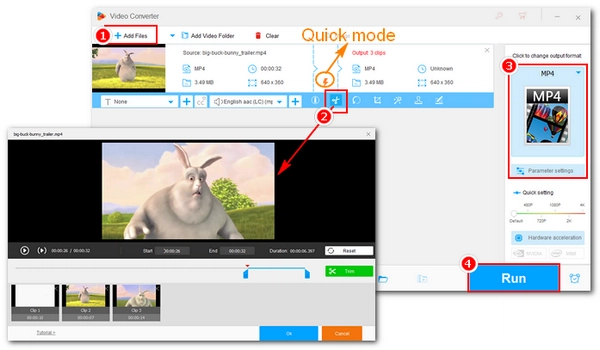
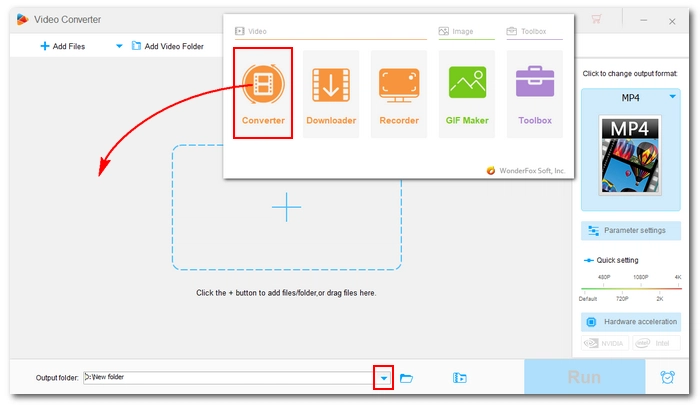
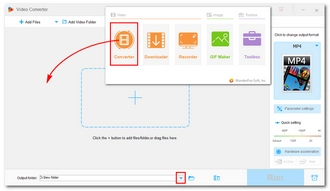
Launch WonderFox HD Video Converter Factory Pro on your PC and open the Converter. Next, click Add File to import your video into the program. Drag-and-drop is also supported.
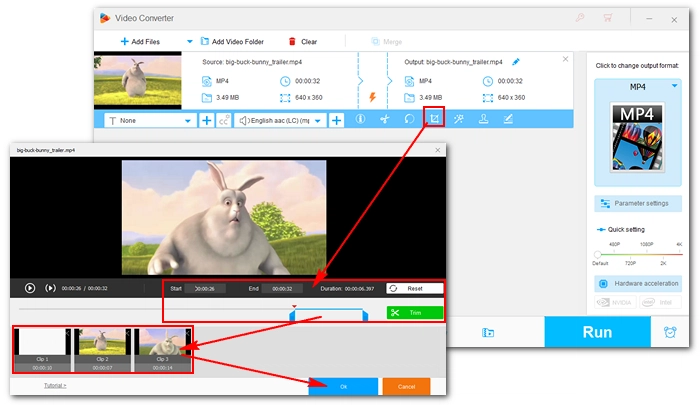
Click the scissors icon to open the Trim window.
Drag the two sliders on the timeline or input the start time and end time to select the segment you want to keep. Use the Play button (▶) to preview the selected part, and click Trim to cut the clip. You can repeat this step to split the video into multiple parts.
After trimming, click OK to save the changes.
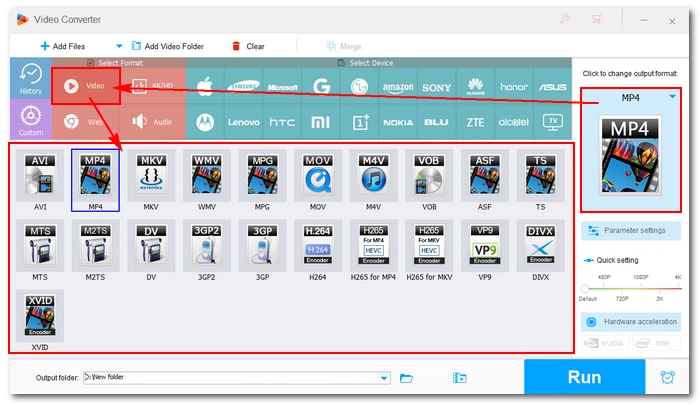
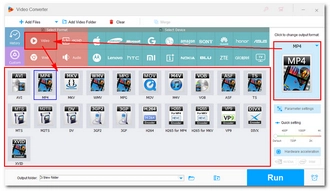
Expand the output format page on the right. Under the Video tab, select the original video format.
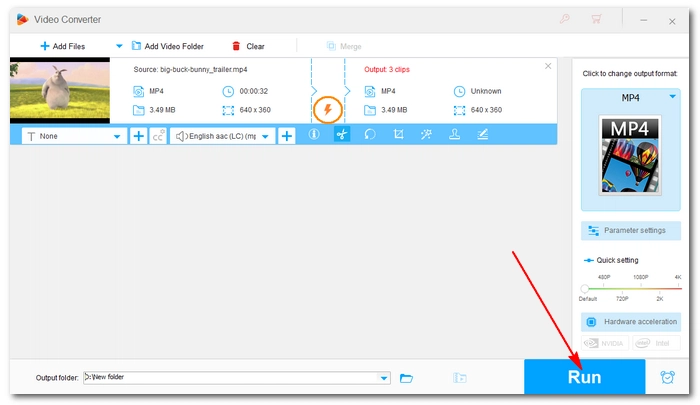
💡 When selecting the original format, the program automatically keeps the identical video parameters to activate Lightning Mode (a lightning icon ⚡ will appear) to ensure lossless video processing. But the audio is set to use AAC to avoid compatibility issues. If you don't want your audio to be re-encoded, go to Parameter settings and keep the audio encoder same as the source file. You can click the ⓘ icon of the video to check its audio encoder.
Click the ▼ button at the bottom to set an output folder. Finally, click Run to finish the video trimming process.
💡 The process is almost instant. But depending on the exporting file size and length, it can take longer. During my test, cutting a 2-hour movie to a 1-hour clip without re-encoding takes about one minute.
When there are unnecessary parts in a video, it's natural that you want to trim it. With the powerful video cutter introduced above, you can quickly trim a video without losing any quality on a Windows PC. The entire process is simple and quick. If you have more editing needs, such as merging, cropping, rotating, applying filters, or managing audio tracks and subtitles, this program will also come in handy.
That's it for now and I hope this guide has been useful to you. Now, you can download download the software to try it out now.
Download for Free
Download for Free
Yes. You can do this in WonderFox HD Video Converter Factory Pro, which can cut multiple clips from a video without re-encoding, provided the output settings match the original.
Yes. You can use the -c copy commands to achieve that.
This occurs because the video editor re-encodes the video using a higher bitrate. To avoid this, you can use a tool that supports lossless trimming to keep the original encoding settings during processing.
If the conversion involves re-encoding the video stream, quality will decrease inevitably. But if you simply change the container format (e.g., from MP4 to MKV) while keeping the encoding parameters unchanged, the process is lossless.

I write about multimedia topics, including video and audio conversion, compression, editing, and downloading. I joined WonderFox in 2020, and my goal is to help readers solve everyday tech problems more easily. In this article, I have shown you the most efficient way to trim videos without losing quality on a Windows machine. Hope you find it useful!


I write about multimedia topics, including video and audio conversion, compression, editing, and downloading. I joined WonderFox in 2020, and my goal is to help readers solve everyday tech problems more easily. In this article, I have shown you the most efficient way to trim videos without losing quality on a Windows machine. Hope you find it useful!

WonderFox DVD Ripper Pro
WonderFox DVD Ripper Pro is a professional DVD ripping program that can easily rip any DVD, be it homemade or commercial, to all popular formats including MP4, MKV, MP3, WAV, H264, H265, Android, iPhone, etc. without a hitch. It also lets you edit and compress DVD videos at high efficiency. Download it to enjoy fast and trouble-free DVD ripping experience.
Download for Free
Download for Free

Terms and Conditions | Privacy Policy | License Agreement | Copyright © 2009-2026 WonderFox Soft, Inc.All Rights Reserved