


Need to trim a recording, clean up noise, arrange several tracks, or make a quick edit in your browser? This guide compares 9 practical audio editors for different skill levels and workflows. Some are completely free and open-source, while a few use a free tier or have limits on official downloads. We point out those differences so you can choose a tool that actually fits your needs.
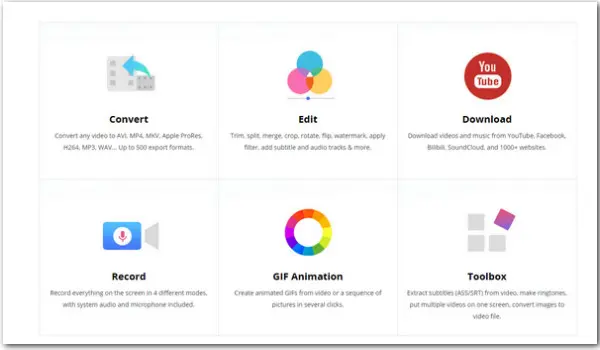
There are times when you might come across an audio not supported error when importing the file into an editor. The best solution is to convert the audio to an editor-compatible format for hassle-free editing. With WonderFox HD Video Converter Factory Pro, you can convert any audio to a needed format within 3 steps!
 Download for Free
Download for Free
Download for Free
Before choosing an editor, think about what you really need: simple waveform cutting or multitrack production, desktop or browser use, offline access, supported file formats, and whether a free plan has export or credit limits. The 9 options below cover everything from quick beginner edits to music production.
Hot Search: 9 Online Video Editors | 13 Video Editors for Windows 11
A strong all-round free editor for recording, cleanup, effects, and multitrack work.
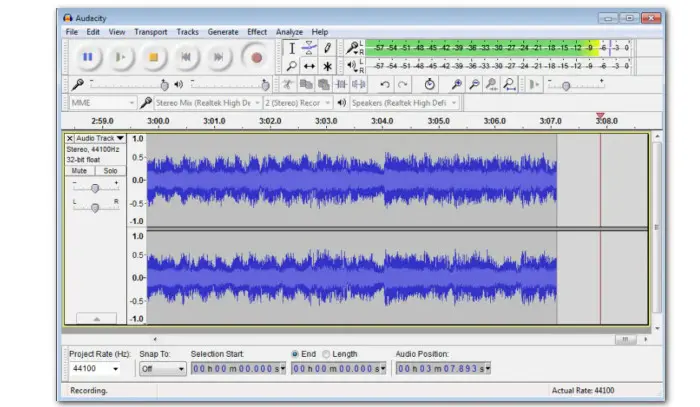
Audacity is a free, open-source multitrack audio editor and recorder for Windows, macOS, and Linux. It works well for both quick edits and more involved podcast, voice, and music projects. You can cut and rearrange clips, record audio, reduce noise, change pitch or speed, use compressors and EQ, view spectrograms, and extend the program with VST3 and Nyquist plugins. Optional FFmpeg support also expands the range of formats you can import and export.
Reasons to recommend:
Free and open-source
Available on Windows, macOS, and Linux
Multitrack editing and recording
Rich built-in effects and analysis tools
Plugin support for expanding features
Reasons to avoid:
The interface can feel busy to first-time users
Some file formats require the optional FFmpeg library
Available for: Windows, macOS, Linux
A fast single-file editor with real-time effect preview and strong waveform tools.
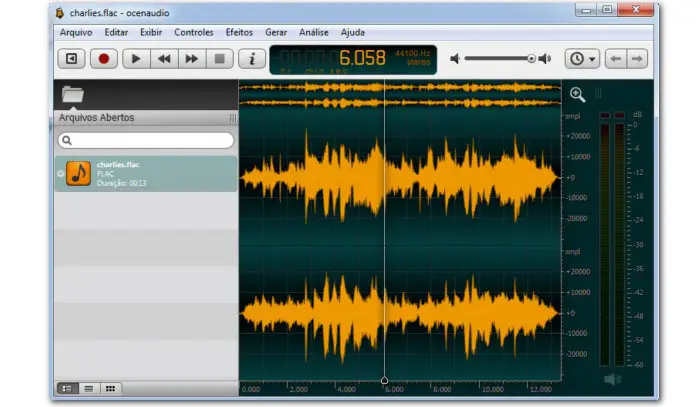
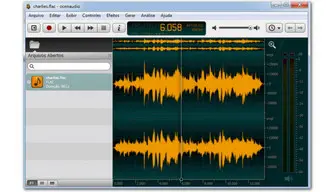
Ocenaudio is a fast cross-platform editor for Windows, macOS, and Linux. It focuses on single-file waveform editing rather than a full multitrack DAW, which makes it easier to learn. Its highlights include real-time effect preview, multi-selection for editing several regions at once, a detailed spectrogram, efficient handling of long files, and support for VST/VST3 effects. Recent versions have also expanded format and metadata support.
Reasons to recommend:
Free to use
Clean and responsive interface
Real-time effect preview
Multi-selection and strong spectrogram tools
VST/VST3 plugin support
Reasons to avoid:
No multitrack timeline for arranging a full project
Fewer production and mixing tools than a full DAW
Available for: Windows 10/11, macOS, Linux
A classic desktop waveform editor with recording, effects, and batch tools.
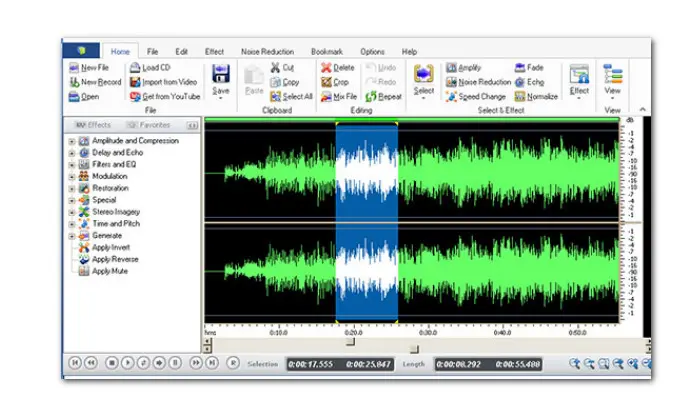
FAEMedia Free Audio Editor is a traditional waveform editor and recorder for Windows and Mac. It includes familiar cut, copy, paste, trim, noise-reduction, effect, format-conversion, and batch-processing tools. Its interface and website feel more old-school than newer editors, but the program can still be useful if you prefer a classic desktop workflow with a broad set of utilities in one place.
Reasons to recommend:
Free desktop editor
Familiar waveform-based editing
Wide input format support
Audio effects, recording, and batch processing
Extra tools for conversion and joining
Reasons to avoid:
No modern multitrack DAW workflow
Interface and documentation feel dated compared with Audacity or Ocenaudio
Available for: Windows and Mac
A professional open-source DAW, with an important caveat on official prebuilt downloads.
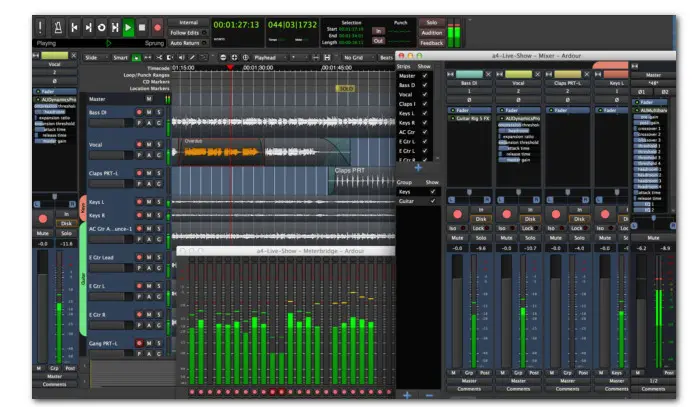
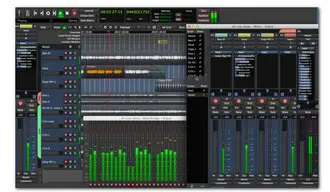
Ardour is a professional open-source DAW for recording, editing, mixing, and MIDI work on Windows, macOS, and Linux. It offers non-destructive editing, automation, plugin support, flexible routing, and a deep multitrack workflow. There is an important pricing detail, however: the source code is free under the GPL, but Ardour’s official ready-to-run full builds generally require payment or a subscription. A free/demo build is available with an audio-silencing limitation, so this is best viewed as an open-source option rather than the easiest zero-cost download.
Reasons to recommend:
Professional multitrack recording and editing
Non-destructive workflow and flexible routing
Strong MIDI and automation tools
Supports plugins such as VST, LV2, and Audio Units
Open-source code
Reasons to avoid:
Steeper learning curve than basic waveform editors
Official full ready-to-run builds are not completely free
Available for: Windows, macOS, Linux
This free music editor is great for beginners to create and edit music on Mac.
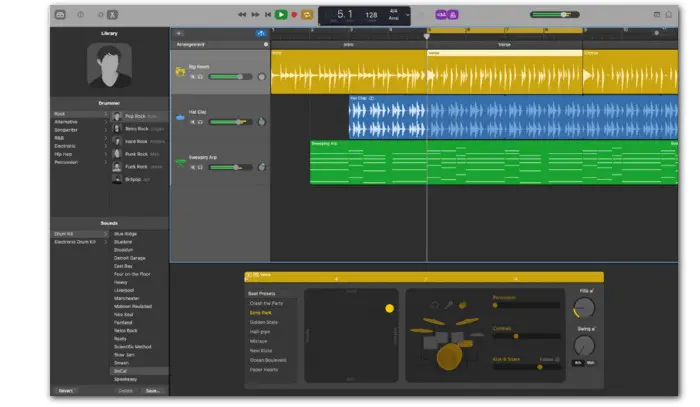
GarageBand is Apple’s free music creation and recording app for Mac, iPhone, and iPad. It combines multitrack recording with virtual instruments, loops, amps, effects, automation, and easy region editing. You can import audio, split and move regions, trim recordings, adjust timing and pitch, and build complete songs without moving to a professional DAW right away.
Reasons to recommend:
Free on supported Apple devices
Friendly interface for music creation
Multitrack recording and non-destructive region editing
Large sound and loop library
Supports MIDI input
Reasons to avoid:
Available only in the Apple ecosystem
Less flexible for advanced mixing, restoration, and studio workflows than Logic Pro or full professional DAWs
Available for: macOS, iPhone, iPad
A tiny portable Windows editor for classic waveform and VST-based work.
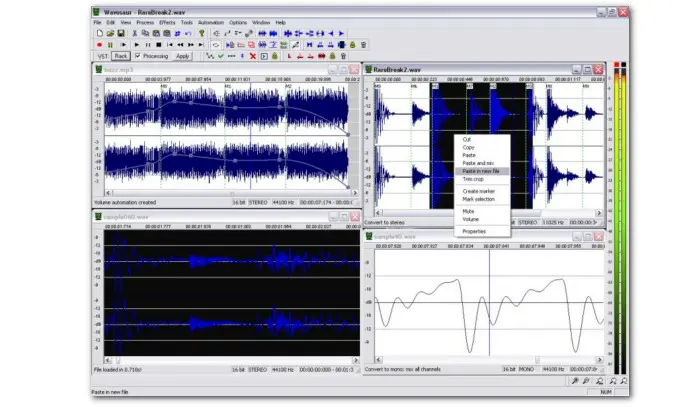
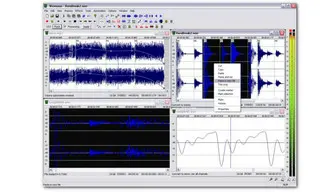
Wavosaur is a tiny portable Windows audio editor that runs without an installer. It covers classic waveform tasks such as cut, copy, paste, trim, normalize, resample, bit-depth conversion, loop editing, recording, analysis, and batch processing. It also supports VST effects, ASIO, and multichannel WAV files. The latest official download is still lightweight, although the interface and much of the documentation retain an older Windows look.
Reasons to recommend:
Portable and very lightweight
Classic waveform editing and recording tools
VST and ASIO support
Multichannel WAV support
Batch processing and analysis features
Reasons to avoid:
Dated interface and documentation
Windows-only and less beginner-friendly than newer editors
Available for: Windows
A convenient browser editor with basic tools and AI-assisted audio features.
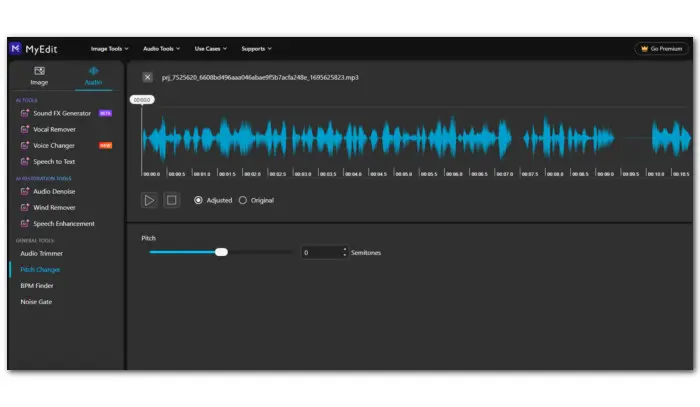
MyEdit is CyberLink’s web-based editor for quick audio tasks and AI-assisted processing. You can trim and merge clips, remove background or wind noise, enhance speech, change voices, separate vocals, adjust pitch, find BPM, and use speech-to-text tools without installing desktop software. It follows a freemium model, so many tools can be tried for free while heavier use and some AI features depend on daily credits or a paid plan.
Reasons to recommend:
No installation required
Easy guided tools for common audio jobs
Useful AI cleanup and voice features
Works in a desktop or mobile browser
Reasons to avoid:
Free use has credit and project-length limits
Some advanced tools and heavier use require a subscription
Available for: Browser
A free open-source browser editor that now also supports multitrack projects.
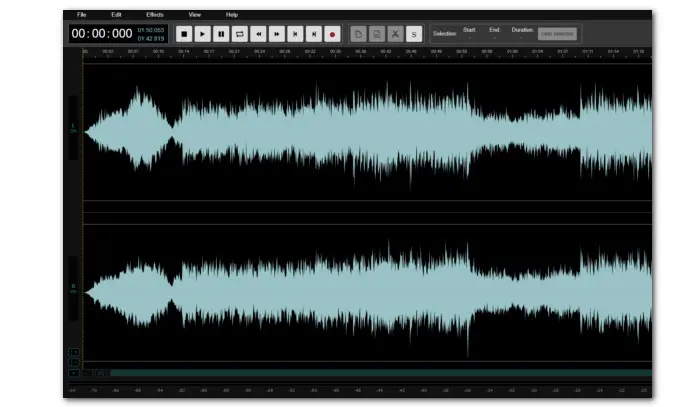
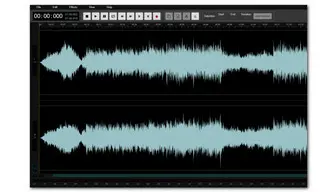
AudioMass is a free, open-source web audio editor that runs locally in the browser with no backend dependency. It has grown beyond simple waveform cutting: current versions include recording, effects, repair tools, pitch and speed processing, markers, beat tools, offline use after loading, and a multitrack mode for layering clips, crossfades, per-track volume and pan, recording, and mixdown. Multitrack sessions can also be saved and reopened as project files.
Reasons to recommend:
Free and open-source
Runs in the browser without an account
Single-track and multitrack editing
Recording, effects, repair, and offline support
No backend dependency for normal editing
Reasons to avoid:
Browser decoding and performance can vary with very large files
Not as optimized for mobile as a dedicated mobile editor
Available for: Browser
A free browser DAW for building, arranging, and collaborating on music projects.
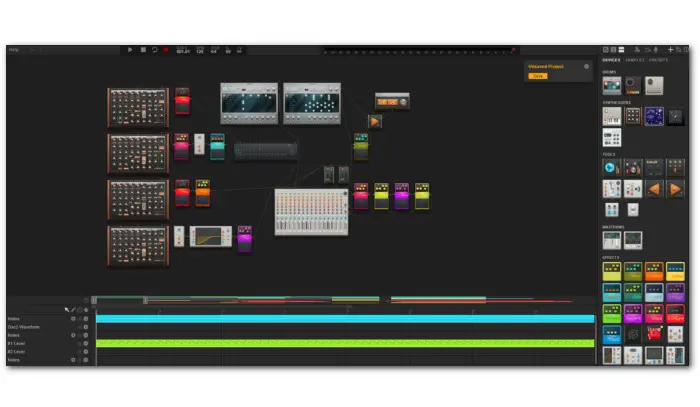
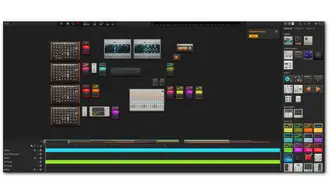
Audiotool is a free online DAW built for music production rather than quick one-file trimming. It runs in a modern browser and provides virtual instruments, synthesizers, drum machines, effects, routing, a large community sample and preset library, cloud projects, and real-time collaboration. It is a good fit when you want to compose or arrange music with other people, but it is more complex than a basic waveform editor.
Reasons to recommend:
Free browser-based DAW
Deep routing, instruments, effects, and arrangement tools
Large community sample and preset library
Real-time collaboration
Cloud access to projects
Reasons to avoid:
More resource-intensive than simple web editors
Requires a learning curve and a recent supported browser
Available for: Browser
 Download for Free
Download for Free
Download for Free
1. What’s the best free audio editing software?
For most beginners, Audacity is the best all-round choice because it is fully free, open-source, cross-platform, and capable of both basic and multitrack editing. Ocenaudio is easier if you mainly edit one file at a time. GarageBand is an excellent free option for music creation on Apple devices, while AudioMass is convenient when you want to work in a browser without installing software.
2. What is the best free audio editing software for Windows 11/10?
Audacity and Ocenaudio are the easiest desktop recommendations for most Windows 11/10 users. Wavosaur is useful if you want a tiny portable editor, while MyEdit, AudioMass, and Audiotool run in a browser. Ardour is also available for Windows, but keep in mind that its official full ready-to-run builds are not completely free.
3. Is Audacity 100% free?
Yes. Audacity is free and open-source for Windows, macOS, and Linux. You can download it from the official Audacity website without paying. Optional components such as FFmpeg may be needed for some additional file formats.
4. Do I need a dedicated WMA editor to edit WMA files?
No. A format-specific WMA editor is usually unnecessary. Audacity can import and export WMA after you install the optional FFmpeg library. Recent ocenaudio releases also support WMA export. If you only need simple Windows tasks such as trimming, splitting, merging, adjusting volume or bitrate, editing metadata, or converting the result, WonderFox Free HD Video Converter Factory is another straightforward option: add the WMA file, use the scissor or merge tools as needed, choose an output format, and click Run. This is more practical than relying on an old WMA-only utility.
There is no single editor that is best for every job. Audacity is the safest all-round starting point, Ocenaudio is excellent for fast single-file edits, GarageBand and Audiotool are better for music creation, and AudioMass is a capable no-install browser choice. Check each tool’s platform, format support, and free-use limits before you start a larger project. Thanks for reading!

Kevincy joined the WonderFox team in 2014 and has been a senior columnist ever since. With over two decades of experience in the video editing industry, he shares tutorials, tips, and how-to guides on video/audio processing and personal DVD backups. Family-oriented and passionate about helping others, he is dedicated to making video and audio processing easier for readers.


Kevincy joined the WonderFox team in 2014 and has been a senior columnist ever since. With over two decades of experience in the video editing industry, he shares tutorials, tips, and how-to guides on video/audio processing and personal DVD backups. Family-oriented and passionate about helping others, he is dedicated to making video and audio processing easier for readers.

Terms and Conditions | Privacy Policy | License Agreement | Copyright © 2009-2026 WonderFox Soft, Inc. All Rights Reserved