



FLV (Flash Video) was once widely used for web video and streaming because it loaded quickly and kept file sizes small. With the end of Adobe Flash and the rise of HTML5, FLV has become increasingly outdated, and as a result, harder to play on modern devices.
Today, however, most browsers, phones, TVs, editors, and social platforms work better with MP4, especially MP4 encoded with H.264 video and AAC audio.
So when an old downloaded FLV video, a screen recording, or an OBS FLV file will not open properly, converting FLV to MP4 is usually the easiest fix. MP4 is easier to play, edit, upload, share, and store across Windows, macOS, iPhone, Android, TVs, and most media apps.
This guide combines several practical FLV-to-MP4 situations into one place: free desktop conversion, HandBrake conversion, FFmpeg commands, online FLV converters, VLC conversion, and OBS remuxing for recordings. Choose the method that fits your file and your workflow.
WonderFox Free HD Video Converter Factory is the easiest option for most Windows users. It supports FLV, MP4, MKV, WMV, WebM, MOV, AVI, MP3, WAV, and many other video and audio formats. You can convert FLV to MP4 with only a few clicks and keep the settings simple, or open "Parameter settings" to change the encoder, resolution, bitrate, frame rate, aspect ratio, volume, and more.
It is also useful when the FLV file needs a small edit before conversion. You can trim unwanted parts, crop black bars, rotate or flip the video, add subtitles, apply effects, and compress the output. For the best compatibility, choose MP4 and keep the video encoder as H.264.
DownloadDownload the free FLV to MP4 converter below and follow the simple steps.
Free HD Video Converter Factory lets you convert FLV and other common or uncommon videos to MP4 without a watermark. It is free, simple, and suitable for daily format conversion on Windows.
 Download for Free
Download for Free
Download for Free
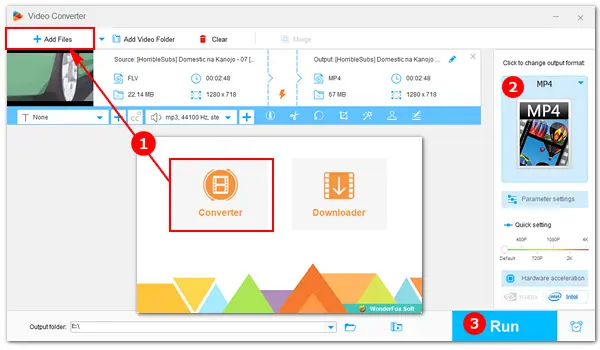
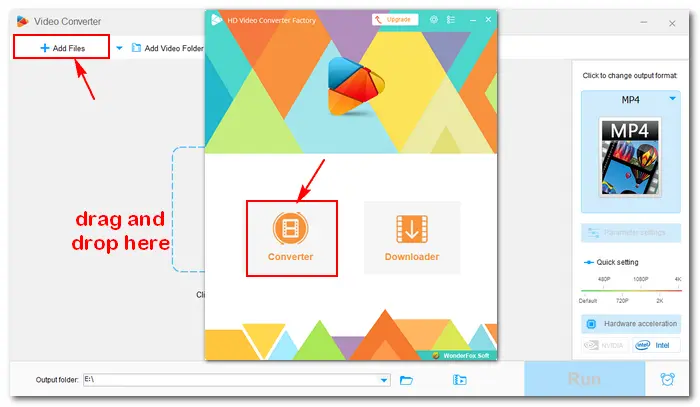
Launch Free HD Video Converter Factory and choose Converter on the main interface. Click Add Files to import your FLV video, or drag the file directly into the program.
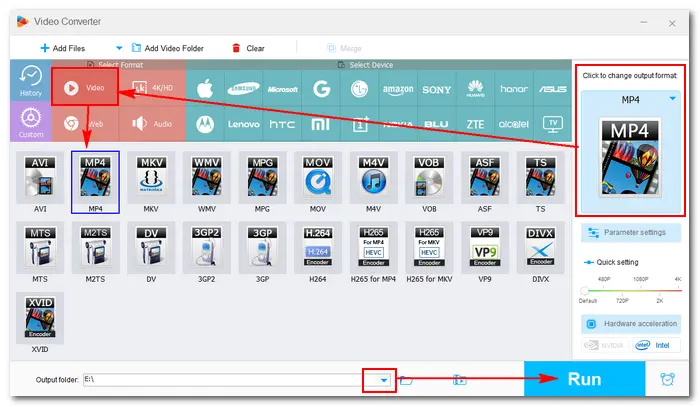
Click the format image on the right side, go to Video, and select MP4. If you want a highly compatible file, open Parameter settings and set the video encoder to H.264. You can also leave the default "Smart Fit" settings unchanged for a balanced result.
Optional: Use the toolbar under the imported video to trim, crop, rotate, add effects, or add subtitles before conversion.
Click the ▼ button at the bottom to choose an output folder. Then press Run to start the conversion. When the process is complete, open the destination folder and check the new MP4 file.
💡 Need to convert many FLV videos at once? WonderFox HD Video Converter Factory Pro adds batch conversion and GPU acceleration, which is helpful for large collections, long videos, and repeated conversion tasks. The basic FLV to MP4 workflow is almost the same as the free version: import files, choose MP4, and click Run.
HD Video Converter Factory Pro can batch convert FLV files to MP4, compress videos, download online videos, record screen, and make GIFs. It is optional, but useful when you need faster bulk processing.
Download for Free
Download for Free
HandBrake is a free, open-source transcoder for Windows, macOS, and Linux. It can open many video files and convert them to modern formats. It is a good choice when you want detailed control over quality, dimensions, filters, subtitles, and codecs.
One thing to note: HandBrake is mainly a transcoder, not a general format converter with hundreds of output choices. Its current output containers are MP4, MKV, MOV, and WebM. For FLV to MP4, that is enough, but it is less flexible than a dedicated converter if you need many different output formats.
Get HandBrake from the official website→
How to convert FLV to MP4 with HandBrake?
Step 1: Install and run HandBrake on your computer.
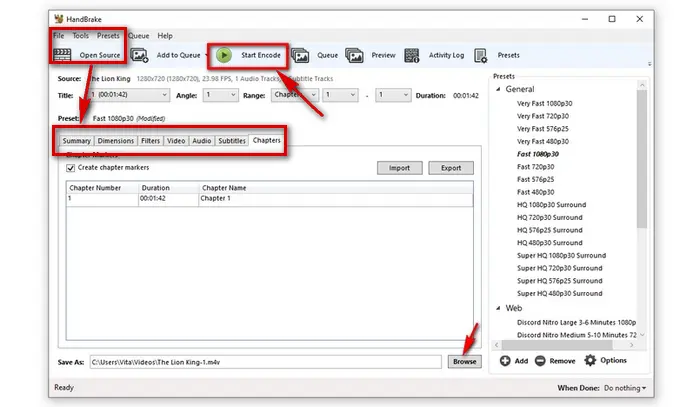
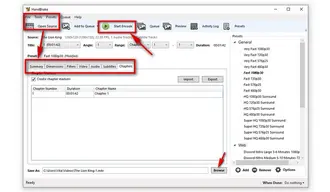
Step 2: On the "Source Selection" page, click File to load the FLV video. You can also drag and drop the video into the program.
Step 3: Under the "Summary" tab, choose MP4 from the "Format" drop-down list.
Step 4: Choose a preset, resize the video, or adjust options under "Dimensions", "Filters", "Video", "Audio", and "Subtitles" as needed.
Step 5: Click Browse to rename the file and select an output folder.
Step 6: Press Start Encode to convert the FLV file to MP4.
FFmpeg is a powerful free command-line tool for processing video and audio. It is not the most beginner-friendly option, but it is fast and flexible once you know the right command.
There are two common ways to use FFmpeg for FLV to MP4:
Option 1: Remux without re-encoding. If the video and audio streams inside the FLV file are already compatible with MP4, use stream copy. This is very fast and does not reduce quality:
ffmpeg -i input.flv -c copy output.mp4
Option 2: Re-encode for better compatibility. If the copied MP4 will not play, re-encode it to H.264 video and AAC audio:
ffmpeg -i input.flv -c:v libx264 -c:a aac output.mp4
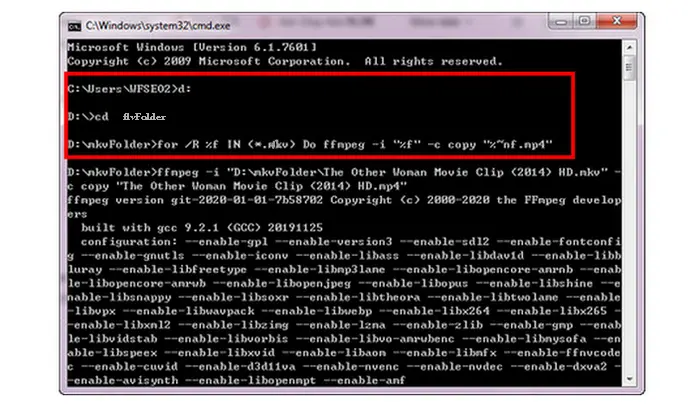
To batch convert all FLV files in the current folder on Windows Command Prompt, you can use:
for %f in (*.flv) do ffmpeg -i "%f" -c copy "%~nf.mp4"
If you put the command in a .bat file, use %%f instead of %f.
Online FLV to MP4 converters are convenient when you only have one or two small files and do not want to install software. They work in a browser on Windows, Mac, and mobile devices. However, they are not always truly "no limit". Many online services limit file size, daily conversions, upload speed, queue priority, or advanced settings on free plans.
CloudConvert is a popular choice. It supports FLV to MP4 conversion, cloud imports, URL imports, and optional settings such as resolution, aspect ratio, codec, trimming, subtitles, and watermark. But large files and many daily conversions may require a paid plan.
How to convert FLV to MP4 with CloudConvert?
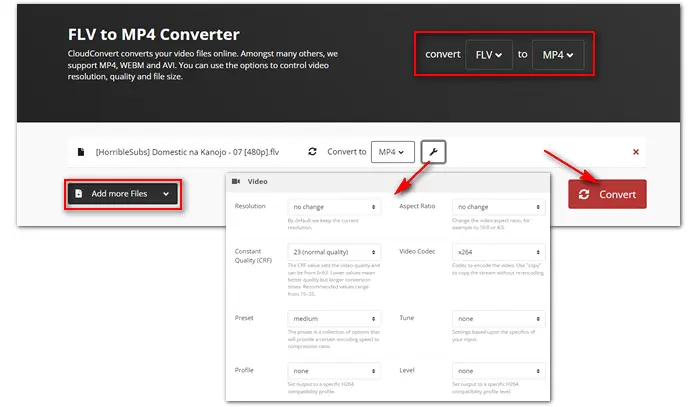
Step 1: Visit https://cloudconvert.com/flv-to-mp4.
Step 2: Click Select File to upload your FLV video from your computer, cloud storage, or URL.
Step 3: Confirm that the output format is MP4. Click the wrench icon if you need to change codec, resolution, aspect ratio, trim length, or add subtitles.
Step 4: Click Convert. After the upload and conversion are finished, download the MP4 file.
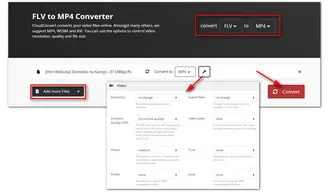
Other online options such as MP4.to and FreeConvert can also handle FLV to MP4 conversion. They may be useful for larger single files, but always check the current file-size limit, privacy policy, and upload restrictions before using them. For private, large, or many videos, a desktop converter is safer and more stable.
VLC is mainly a media player, but it also includes a basic conversion feature. It is worth trying if VLC is already installed and you only need a simple FLV to MP4 conversion. Compared with dedicated converters, VLC gives fewer output controls and may fail on some damaged or unusual FLV files. If you do not have VLC yet, get it from the official VideoLAN website.
On Windows:
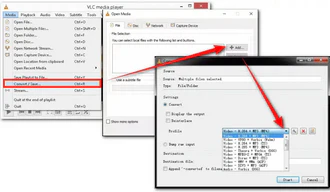
Step 1: Open VLC and go to Media > Convert/Save. You can also press Ctrl + R.
Step 2: Click Add to import the FLV file, then click Convert/Save.
Step 3: Choose Video - H.264 + MP3 (MP4) from the Profile list. For broader playback compatibility, you can click the wrench icon, open Audio codec, and switch the audio codec to MPEG 4 Audio (AAC).
Step 4: Click Browse to choose a destination file and make sure the file extension is .mp4.
Step 5: Click Start to begin conversion.
On Mac: Open VLC, go to File > Convert/Stream, add the FLV file, choose the MP4 profile, save it as a file, and start the conversion.
VLC-converted MP4 has no sound? First, update VLC and try the conversion again. If the issue remains, click the wrench icon beside the selected profile and open Audio codec. If the source audio is already suitable for MP4, try Keep original audio track. Otherwise, choose MPEG 4 Audio (AAC) and, if needed, set the sample rate to 48000 Hz. Save the profile and reconvert the file. If VLC still produces a silent or unplayable MP4, use another converter instead.
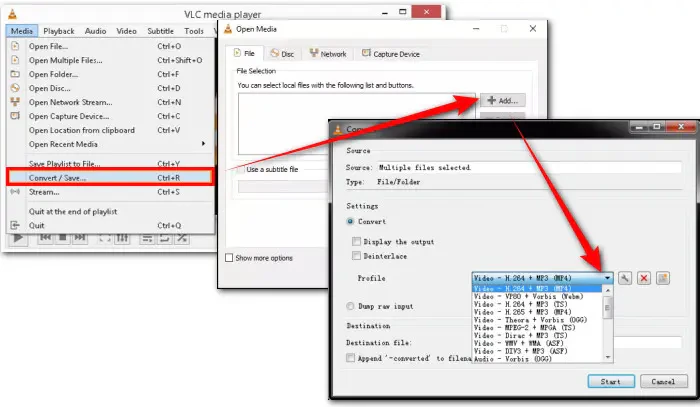
If your FLV file was recorded by OBS, you may not need a full re-encode. OBS has a built-in remuxing feature that can change a recording container from FLV to MP4. Remuxing is usually much faster than conversion and does not change the original video quality.
How to remux OBS FLV to MP4?
Step 1: Open OBS Studio and click File > Remux Recordings.
Step 2: Click the three-dot button under OBS Recording and select your FLV recording.
Step 3: Under Target File, choose where to save the output and make sure the extension is .mp4.
Step 4: Click Remux. OBS will create an MP4 copy without re-encoding the recording.
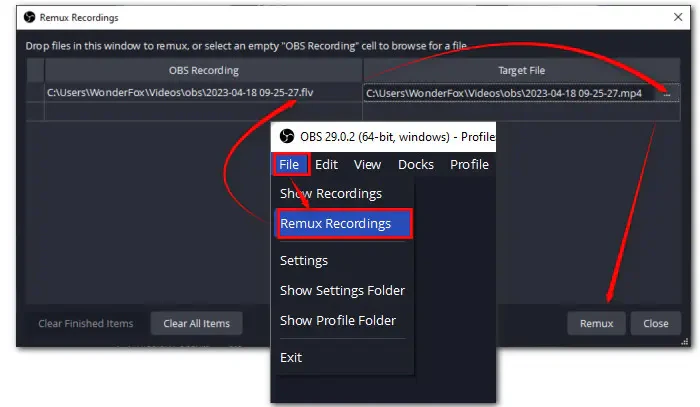
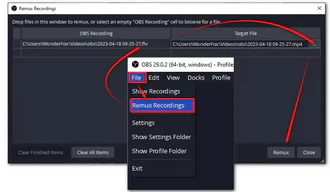
You can also go to Settings > Advanced > Recording and enable Automatically remux to MP4. This lets OBS record in a safer format and automatically create an MP4 after recording.
It is generally better not to record directly in MP4 if you worry about crashes or power loss. When an MP4 recording is interrupted, the file may become unusable. Recording in FLV or MKV first and remuxing afterward is safer.
Q1. Is FLV still used today?
FLV is no longer a mainstream web video format. You may still find it in old downloads, archived videos, legacy websites, and some recording workflows, but MP4 is far easier to play and share today.
Q2. Does converting FLV to MP4 reduce quality?
It depends on the method. Remuxing changes the container only and keeps the original quality. Re-encoding can reduce quality slightly, but using H.264 with proper bitrate or quality settings usually produces a good result.
Q3. Should I use remuxing or conversion?
Use remuxing when the FLV contains MP4-compatible streams and you only need to change the container. Use conversion when the copied MP4 does not play, the codec is unsupported, or you need to resize, compress, edit, or change video/audio settings.
Q4. What is the best MP4 setting for compatibility?
H.264 video with AAC audio in an MP4 container is the safest choice for most devices, players, editors, and websites.
Q5. Can I convert FLV to MP4 online without limits?
Some online tools allow larger files than others, but free online conversion usually still has limits, such as file size, daily tasks, upload speed, or queue priority. Desktop software is better for large, private, or batch conversions.
There is no single best FLV to MP4 method for every situation. For most Windows users, WonderFox Free HD Video Converter Factory is the easiest free solution because it offers a clear interface, common output presets, editing tools, and flexible settings. HandBrake is good for open-source transcoding, FFmpeg is best for command-line users, online converters are convenient for small non-private files, VLC is fine for quick basic conversion, and OBS remuxing is the best choice for OBS FLV recordings.
If you only need one reliable MP4 output setting, choose MP4 with H.264 video and AAC audio. It gives the best balance of compatibility, quality, and file size for everyday playback and sharing.

Kevincy joined the WonderFox team in 2014 and has been a senior columnist ever since. With over two decades of experience in the video editing industry, he shares tutorials, tips, and how-to guides on video/audio processing and personal DVD backups. Family-oriented and passionate about helping others, he is dedicated to making video and audio processing easier for readers.


Kevincy joined the WonderFox team in 2014 and has been a senior columnist ever since. With over two decades of experience in the video editing industry, he shares tutorials, tips, and how-to guides on video/audio processing and personal DVD backups. Family-oriented and passionate about helping others, he is dedicated to making video and audio processing easier for readers.
 Download for Free
Download for Free
Download for Free

Terms and Conditions | Privacy Policy | License Agreement | Copyright © 2009-2026 WonderFox Soft, Inc. All Rights Reserved