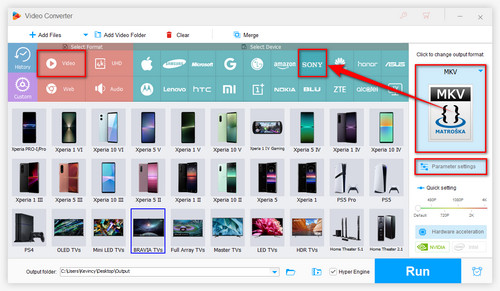
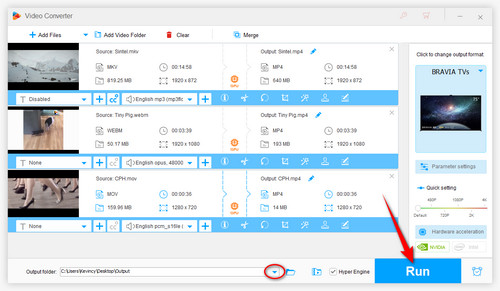
When you find that Sony BRAVIA TV can't play your video, you need to check the following aspects:
1. First, make sure the video file itself is intact. Test it on a computer or another player to rule out corruption, an incomplete transfer, or DRM/encryption.
2. If the file is fine, check the USB storage device. Supported file systems vary by model. Many BRAVIA TVs support FAT16, FAT32, and exFAT, while many newer models also support NTFS. Check your TV's manual before reformatting a drive.
3. Next, check both the container and the codecs inside it. MP4, MKV, AVI, and similar names describe containers, not one fixed encoding. For example, two MKV files can use completely different video and audio codecs, so one may play normally while the other shows an unsupported-format message, has no sound, or refuses to open.
4. Also compare the video parameters with the limits of your TV. Resolution, frame rate, codec profile/level, and sometimes audio channel layout can affect playback even when the container and codec names look correct.
Because Sony BRAVIA covers many TV generations and series, there is no single format list that is accurate for every model. The safest approach is to check the Help Guide for your exact TV.
Here’s how to check your Sony BRAVIA supported video formats via USB.
Step 1. Go to https://www.sony.com/electronics/support/televisions-projectors and search for your exact TV model.
Step 2. Open the product support page and go to Manuals.
Step 3. Open the Help Guide (called iManual on some older models).
Step 4. Look for Supported files and formats, Playable File Formats, or a Codec List under the sections for USB/connected devices. The menu wording differs by TV generation. Compare the listed file extension together with the supported video and audio codecs.



 How to & Tips
 Convert Video

 by




 Free Download
 Product Page
 Windows, 100% Clean!