Free Download
Free download the handy tool to convert MJPEG videos to H.264 MP4.
 Recommended by the authorRecommended by the author
MJPEG-encoded videos can take up much storage and may fail to play smoothly on modern devices, browsers, or editing apps when the required codec is missing. Therefore, this article introduces a simple and useful MJPEG converter to help you convert MJPEG videos to H.264, MP4, and other common formats for easier sharing, playback, and archiving. Read on to learn the details.

In multimedia, MJPEG, also known as Motion JPEG or M-JPEG, is a video compression format in which each video frame or interlaced field of a digital video sequence is compressed separately as a JPEG image. MJPEG is widely used in IP cameras, webcams, digital cameras, video cameras, streaming servers, game consoles, and non-linear video editing systems. MJPEG-encoded videos are commonly saved with .mjpeg or .mjpg filename extensions, and they can also be wrapped in .avi, .mov, or other containers. Because MJPEG is a codec rather than a single file format, playback problems often come from missing codec support or an incompatible container.
MJPEG vs H.264
You may know that MJPEG and H.264 are both video compression formats called codecs. But MJPEG or H.264, which one to choose? Compared with H.264, MJPEG takes a very different approach to video compression. H.264 uses inter-frame compression to reduce repeated information across frames, while MJPEG compresses every frame separately like a sequence of JPEG images. MJPEG can be useful when frame-by-frame editing or camera capture matters, but it is usually inefficient for everyday playback, upload, and sharing.
The defects that MJPEG brings are easy to see as well: low compression ratio, large file size, and high bandwidth consumption. In one word, whether to choose MJPEG or H.264 mainly depends on what users want. For some cameras, surveillance footage, and editing workflows, MJPEG may still be convenient. But for smaller file size, smoother transmission, wider device support, and online upload, H.264 is usually the better choice.
In fact, many people today see MJPEG as an old-fashioned format, especially when a video fails to open in a media player or takes too long to upload. It’s recommended to convert MJPEG to H.264 MP4, H.265, AVI, MOV, or other needed formats, not only to reduce file size, but also to make the video easier to play on phones, TVs, web platforms, and editing software.
Here is a simple way to understand the choice: H.264 is a video codec, while MP4 is a container format. In most real-life cases, people who say they want to convert MJPEG to MP4 actually want an MP4 file encoded with H.264, because this combination works well on Windows, macOS, iPhone, Android, smart TVs, YouTube, and many editing programs.
If your goal is to keep the file easy to open and share, choose MP4 with H.264. If you specifically need an H.264 elementary stream or another container for a particular workflow, choose the H.264 profile or a suitable container manually. If you only need the audio from an MJPEG video, you can extract it to MP3, WAV, AAC, or other audio formats.
MJPEG suffers from quite a lot of disadvantages that make it less convenient than H.264. In this case, you can convert MJPEG to H.264 or MP4 for better playback and distribution.
WonderFox HD Video Converter Factory Pro should be the best choice for you to finish the conversion. It's a multifunctional video & audio converter with over 500 codecs, formats and devices available. Besides MJPEG to H.264, conversions like MJPEG to MP4, MJPEG to MOV, MJPEG to AVI, and MJPEG to MP3 are also supported. You can also batch convert a folder of MJPEG files, preview videos before conversion, and modify parameters such as encoder, resolution, frame rate, bitrate, aspect ratio, and audio settings when needed.
Free download the best convenient MJPEG converter to change MJPEG format.
Launch WonderFox HD Video Converter Factory Pro. Press Converter icon. Click "Add Files" to import your MJPEG-encoded videos. Or you can drag and drop MJPEG files to the interface. Meanwhile, batch conversion is supported.
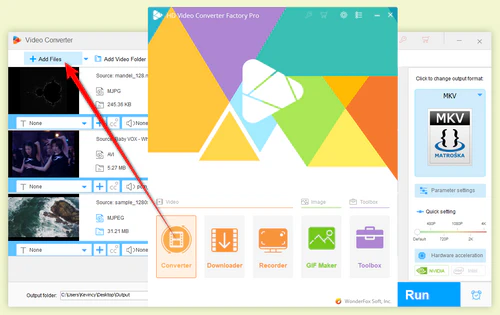
Add MJPEG video files
Open the "Output Format" list on the right side. Choose H.264 under the "Video" category for better compatibility. You can also manually choose "MP4" and keep H.264 as the video encoder, so the result will be an H.264 MP4 file. For advanced users, click "Parameter Settings" to adjust the frame rate, bitrate, aspect ratio, resolution, audio codec, and more.
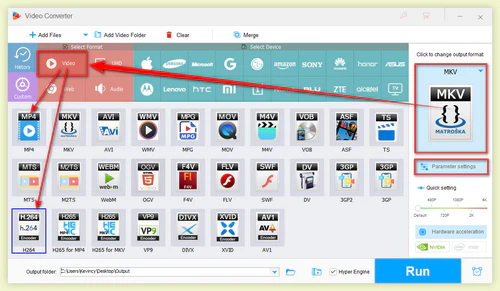
Choose H.264 or MP4
Choose an output folder at the bottom of the interface. Finally, click "Run" to convert MJPEG videos to H.264 or MP4. If you have GPU acceleration enabled, the conversion can be faster, especially when processing large or multiple files. After the conversion, you can find the output video in the folder you preset before.
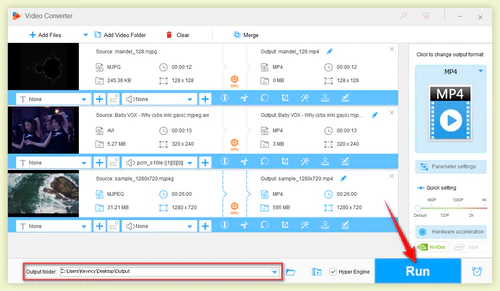
Convert MJPEG to H.264/MP4
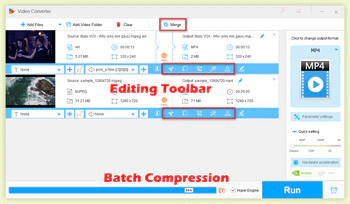
Edit a video
More than just converting MJPEG to H.264 or MP4, WonderFox HD Video Converter Factory Pro can also efficiently help you edit videos before export. After adding videos to the interface, you can combine several videos together to make a longer video or cut video clips to get rid of what you don't want. Rotate, crop, flip, filters, compression, deinterlacing, and watermark tools are also available.
Yes, an online video converter can be helpful when you only have one small MJPEG or MJPG file and do not want to install software. Usually, you just upload the file, select MP4 as the output format, adjust optional settings if available, and download the converted file after processing.
However, online tools are not always ideal for large camera recordings or private videos. They may have file-size limits, slow upload speed, unstable processing, ads, or privacy concerns. For multiple MJPEG files, large AVI/MOV recordings, or videos that need parameter changes, a desktop MJPEG converter is more reliable.
Q1: Is MJPEG the same as MP4?
No. MJPEG is a video codec that compresses each frame as a JPEG image. MP4 is a container format that can hold video, audio, subtitles, and metadata. An MJPEG video can be stored in AVI, MOV, MJPEG, MJPG, or other containers.
Q2: Why should I convert MJPEG to MP4?
MP4 with H.264 usually offers a much smaller file size and better compatibility. It is easier to play on phones, tablets, TVs, media players, browsers, and upload platforms.
Q3: Will converting MJPEG to H.264 lower quality?
Any re-encoding may cause some quality change, but the difference can be very small when you use proper bitrate, resolution, and frame rate settings. For everyday playback and sharing, H.264 MP4 often gives a better balance between quality and size.
Q4: Can I batch convert MJPEG videos?
Yes. You can import multiple MJPEG files into the converter, select one output profile such as MP4 or H.264, and convert them together.
Q5: What should I do if an MJPEG video has no sound after conversion?
First, preview the source file and check whether it contains an audio track. If it does, open Parameter Settings and choose a common audio codec such as AAC for MP4 output. Also make sure the player is not muted.
MJPEG is still useful in some cameras, recorders, and older workflows, but it is not always the best format for daily playback, sharing, or storage. If your MJPEG files are too large, fail to play on certain devices, or need to be uploaded online, converting them to H.264 or MP4 is a practical fix. With WonderFox HD Video Converter Factory Pro, you can convert single or multiple MJPEG videos, adjust output settings, and make the files easier to play, send, and store without a complicated setup.

Kevincy joined the WonderFox team in 2014 and has been a senior columnist ever since. With over two decades of experience in the video editing industry, he shares tutorials, tips, and how-to guides on video/audio processing and personal DVD backups. Family-oriented and passionate about helping others, he is dedicated to making video and audio processing easier for readers.


More Practical Features of HD Video Converter Factory Pro
Tips Center | Rip DVD | Convert Video | Video and Device | Download YouTube | About | Contact | Affiliate | Privacy | News
Copyright © 2009-2026 WonderFox Soft, Inc. All Rights Reserved.