Free Download
Best tool to save audio from supported websites with a simple URL.
AuthorRecommended by the author

SoftwareHow to & Tips

Video FormatsConvert Video

Resources

How to Download Music from Websites Safely (2026 Updated)

Author: Kevincy by Kevincy

Updated on Aug 25, 2026

How to download music from websites when there is no obvious download button? This article explains three practical ways to save downloadable music, background audio, podcasts, and other web audio for offline playback or personal projects. For a simple URL-based workflow, install this efficient music downloader and follow the guide below:

Different Ways to Download Audio Files from Websites

There are several ways to download music from websites when the audio is available to save. First, check whether the website itself provides an official download, purchase, or offline-listening option. If not, you can use a simple music downloader to analyze a music or video URL and save an available, unprotected audio stream. You can also inspect a webpage to find a direct embedded audio link, such as MP3, M4A, AAC, OGG, WAV, or FLAC. If the page only allows normal playback and you have permission to keep a personal copy, an audio recorder can capture the sound in real time. The methods below cover these common cases without encouraging copyright infringement or DRM bypassing.

Only download audio you own, are authorized to save, or that is clearly offered under a license allowing downloads. Do not use any method in this guide to download copyright content for commercial purpose and other illegal intentions.

Method 1: Use a Dedicated Music Downloader (Easiest)

Before using a third-party downloader, check for an official download button first. Music marketplaces and download stores may give you a real audio file together with clearer usage rights. For example, BeatStars creators can offer free downloads under specific license terms, while purchased beats can be downloaded from the buyer’s order. Stores such as Qobuz also sell DRM-free music downloads, including native FLAC when that quality is available. These official options are preferable whenever they meet your needs.

For webpages that provide an accessible, unprotected media stream, a URL-based music downloader can be the easiest option. Here I’d introduce WonderFox HD Video Converter Factory Pro. It can analyze music and video links from many supported websites and list the available audio or video options.

The same workflow can be used for jazz, hip-hop, worship, wedding music, gospel, country, Korean, soundtrack, background-music, live-session, audiobook, podcast, and other audio sources. For commercially released music, such as most Disney soundtracks and chart music, use an authorized store, official download, or licensed streaming service instead of treating a playable page as a free download source.

Moreover, the software also helps you extract audio from video, convert audio formats, change audio bitrate, trim, merge, and compress audio files.

Now, get this music downloader and see how to download audio from supported websites with the software below.

Free Download Free Download

How to Download Audio from Websites with HD Video Converter Factory Pro

Download Audio

Before start, please free downloadfree download and install the software on your PC.

Step 1. Open the Add New Download Window

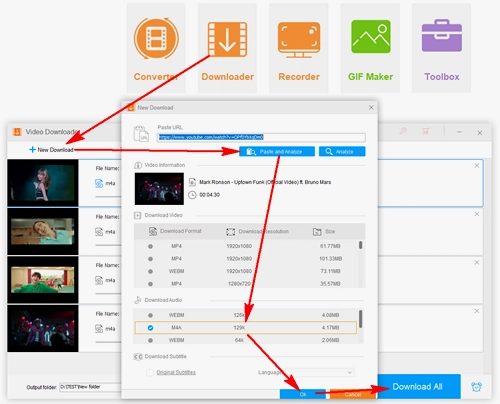
Open the software, go to Downloader, click on + New Download, and the New Download window will pop up.

Step 2. Copy & Paste the Audio URL and Analyze It

Copy the page URL of the audio, music video, playlist, podcast episode, or other allowed source, and paste it into the Paste URL box. Then click on Analyze. Alternatively, you can also click Paste and Analyze.

Step 3. Download Music from Website

Once the analysis process is complete, choose an audio format under Download Audio, then click OK. Choose an output folder and hit Download All to save the audio to your computer. If only video options are available, download the video first and extract the audio in the next step.

Convert Video to MP3

Step 4 (Optional). Convert the Downloaded File

If you didn’t find the desired format in the download options, you can first download the available file and then convert it to the needed format in the Converter module.

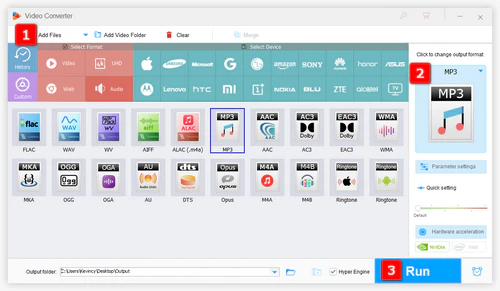
After it finishes downloading, go to Converter, add the downloaded file, click on Output Format on the right of the main interface, go to the Audio tab and select MP3, M4A, AAC, FLAC, WAV, OGG, or another format you want. You can also trim unwanted parts, merge several tracks, or adjust bitrate before clicking Run.

Note: Converting an MP3, AAC, or other lossy source to FLAC cannot restore audio detail that was already removed. If you specifically want lossless music, download or purchase a native lossless file from a source that offers it.

Method 2: Download Embedded Audio via Browser (No Software Needed)

Some websites host audio as a direct embedded file instead of a video stream. This often happens on personal blogs, podcast pages, tutorial pages, music sample pages, royalty-free music sites, and some older social or artist pages. For legacy sites such as Myspace, the exact player and media URL may have changed over time. If the current page exposes a normal downloadable audio file, you can follow the steps below:

Save Audio from WebsiteSave Audio from Website

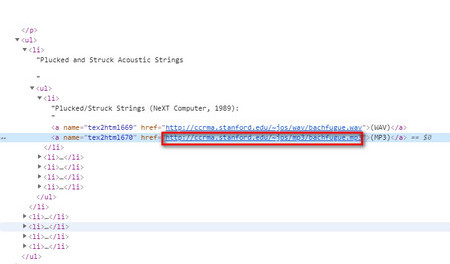
Step 1. Move your cursor over the audio file, download button, or share link, and the file destination may be displayed at the bottom of your browser. If the audio can be downloaded directly, the destination usually ends with .mp3, .m4a, .aac, .ogg, .wav, or .flac. In such cases, right click and select “Save link as” or “Save audio as” to download it. However, if it doesn’t show the destination, move to the next step.

Step 2. Right click on the blank margins of the page, select “Inspect” in Chrome or “Inspect Element” in Firefox to open the Inspect page. Press Ctrl+F, and search for audio file extensions or tags such as mp3, m4a, ogg, wav, <audio>, or source. You can also open the Network tab, refresh the page, play the audio, and filter by Media. Once you locate a direct file address, open it in a new browser tab and download the audio. This method is also useful when you want to download background music that is embedded directly in a webpage.


Tips. If the link opens a streaming playlist, expires quickly, requires account authorization, or returns an error, do not force it. Try the original page URL in Method 1 only when the content is allowed to be saved. For subscription or protected services, use the platform’s official offline feature instead of trying to extract the stream.


Method 3: Record the Audio (When Downloading Is Not Available)

Save Audio from WebsiteRecord Audio from Website

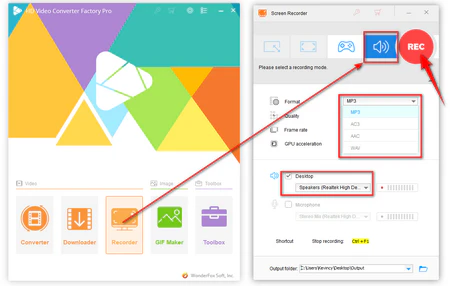
If you cannot find a direct audio address after using Method 2, the webpage may be using a dynamic player or protected stream. Recording the playback is a practical fallback for lectures, podcasts, voice clips, live sessions, and other audio sources.

You can use the Recorder module in WonderFox HD Video Converter Factory Pro to record system audio only, or use a dedicated audio recorder such as Audacity.

Before recording, turn off microphone input if you do not want room noise, set a proper volume, play the web audio from the beginning, and stop recording when it ends. Then trim the silence and export the result to MP3, WAV, or another format you need.

FAQs

Q1. Is it legal to download music from websites?

It depends on the source and license. It is generally fine to download your own audio, public-domain audio, royalty-free music, creator-approved downloads, or podcast episodes that offer a download option. Do not download copyrighted music without permission.


Q2. Can I download music from Deezer, Pandora, Gaana, or other paid streaming services?

Use the service’s official offline feature when your plan and device support it. These downloads are generally intended for playback inside the app, not as ordinary MP3 files you can freely move elsewhere. Pandora, for example, keeps offline content inside the Pandora app, while Gaana states that offline content remains playable in the Gaana app while the Gaana+ subscription is active. Availability can vary by plan, device, and region. Do not use third-party tools to bypass subscription or protection rules.


Q3. Why can’t the downloader analyze my music URL?

The website may have changed its player, hidden the real audio address, required login, blocked third-party analysis, or used protected streaming. Try copying the exact page URL, updating the program, or using the browser method for direct embedded audio files.


Q4. What format should I save music in?

MP3 is the most compatible choice for phones, cars, TVs, and media players. M4A/AAC is good for small size and decent quality. WAV and FLAC are larger but better for editing or keeping a high-quality source. If you want true lossless FLAC, start with a native lossless download; converting a lower-quality MP3 or AAC file to FLAC will not improve its sound quality.


Q5. Can I download background music from a webpage?

Yes, if the background music is directly embedded and allowed to download. You can right-click the audio, inspect the page, or check the Network > Media panel to find the file link. Always check the license before using it in a video, presentation, or commercial project.


Q6. Can I save podcasts or spoken audio from websites?

Yes, if the podcast page provides a download button, direct audio file, or RSS enclosure. If there is no download option, respect the site’s terms and only record playback when you have permission for personal use.


Q7. Do gospel, country, Korean, Disney, or other music genres need different download methods?

No. The technical method depends on how the website delivers the audio, not on the music genre. For royalty-free, public-domain, creator-approved, or purchased tracks, use the site’s download button or the methods above. For copyrighted commercial releases, use an authorized store or the official offline feature provided by the streaming service.

In Summary

This article has introduced three practical methods to download music from websites: use an official download when available, analyze an allowed URL with a downloader, find a direct embedded audio file in the browser, or record permitted playback as a fallback. For most ordinary downloadable web audio, the URL downloader is still a convenient choice because it can save available audio and also convert, trim, merge, and compress the downloaded files. For paid music stores and subscription services, follow their official download and licensing rules. You can download the program to have a try:

Free Download Free Download


Kevincy

Kevincy Berel

Kevincy joined the WonderFox team in 2014 and has been a senior columnist ever since. With over two decades of experience in the video editing industry, he shares tutorials, tips, and how-to guides on video/audio processing and personal DVD backups. Family-oriented and passionate about helping others, he is dedicated to making video and audio processing easier for readers.

Email

Manage Downloaded Music Easily!

WonderFox HD Video Converter Factory Pro

WonderFox HD Video Converter Factory Pro

After saving music from websites, you may still need to convert it to MP3, M4A, WAV, FLAC, or OGG, trim a long recording, merge several clips, reduce file size, or extract audio from a downloaded music video. HD Video Converter Factory Pro brings these audio tools together in one simple Windows program.

Free Download HD Video Converter Factory Pro Free Download HD Video Converter Factory Pro

More Related Articles

Best Free Music Downloaders for PC
How to Extract Audio from Video Easily

WonderFox HD Video Converter Factory Pro

Download videos and music fast & easily!

Support saving available videos and music in bulk from many popular websites, with handy conversion and editing tools.